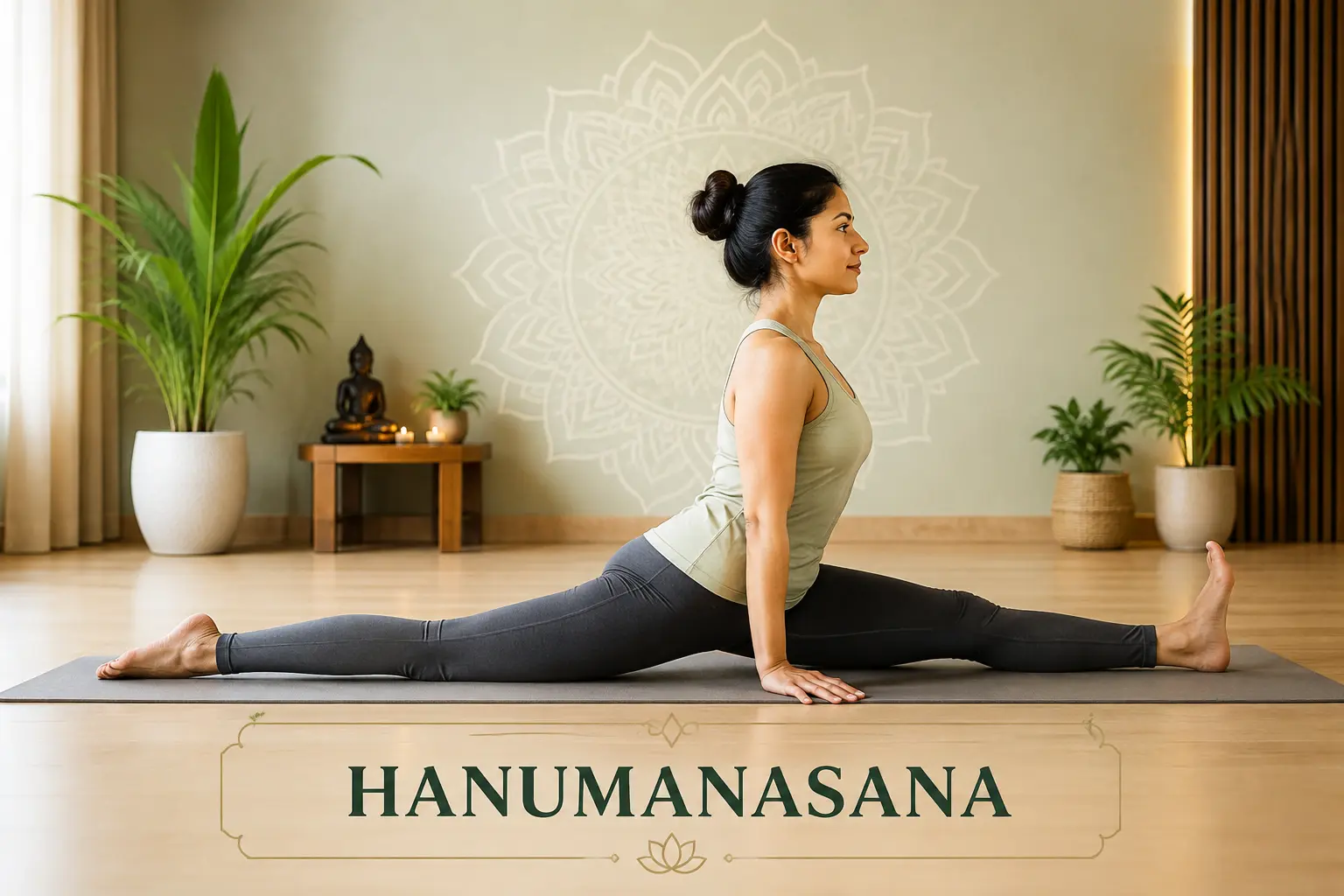
Hanumanasana: Build your Strength
Mastering Hanumanasana (Monkey Pose) is an exercise that can boost your awareness and self-compassion. True yoga practice honors the journey of learning. It teaches us to move through poses with patience rather than rushing toward advanced forms. There are few postures that embody this philosophy as deeply as Hanumanasana. By requiring one leg to stretch fully forward and the other backward, it calls for deep hip mobility, balance, and fine muscular control. Let’s find out more about Hanumanasana and how it can help you with strength building.
Key Takeaways
- Increases hip mobility: Deeply stretches hamstrings, quads, and hip flexors.
- Builds body control: Demands strong pelvic alignment and deep leg stability.
- Requires gradual practice: Advanced posture needing patience and careful warm-up.
What Is Hanumanasana (Monkey Pose)?
The name of the pose is given after the character from the Ramayana called Hanuman, who is known for his tremendous physical power, faithfulness, and great jump. This asana can be compared to a front split with one leg stretched forward and the other leg being drawn backwards.
This asana puts lots of pressure on the hamstrings, quads, hip flexors, glutes, and other muscles of the body. Proper alignment of the pelvis is also essential in this case. Due to the high flexibility required, this yoga pose is not meant for beginners.
How to Practise Hanumanasana (Monkey Pose)
Take up this pose gradually, making sure that the legs are not forcefully taken into this pose.
- Start with the Downward Facing Dog pose and take some deep breaths.
- Raise one leg upwards, followed by placing this leg between the hands.
- Bring down the other leg such that the pose becomes a low lunge.
- Gradually stretch the front leg while doing so in a controlled way.
- Now start moving the front leg forward and the back leg backwards.
- Move till your level of flexibility permits.
- Maintain the pelvis straight ahead rather than tilting to one side.
- Support yourself with the help of hands kept near your legs.
- In case the hips don’t come down easily onto the floor, you can use a yoga block or any other prop under them.
- When you get into the pose, continue breathing in your normal pattern.
- Expert practitioners can join their hands in front of the chest or lift them up.
- In order to get out of the pose, use your hands for support and move back into low lunge and finally Downward Facing Dog pose.
Repeat the practice on the opposite side so that both legs receive equal attention.
Benefits of Hanumanasana
Some of the benefits of practising the Monkey Pose regularly are:
|
|
|
|
|
|
|
|
|
|
|
|
|
|
|
|
|
|
|
|
|
How to Prepare for Hanumanasana
Preparation is one of the most critical elements involved in executing this challenging asana.
Preparation postures are recommended as follows:
- Low Lunge
- High Lunge
- Half Split
- Different variations of Pigeon Pose
- Hamstring stretching
- Quadriceps stretching
- Opening hip flexors
- Leg movements
- A few rounds of Surya Namaskar
It is necessary to prepare on both sides and progressively intensify the preparation process. A warmed-up body is always better equipped to handle flexibility exercises than a cold body that goes straight into an intense stretch.
Precautions
Performing Hanumanasana must be done patiently and in regard to the flexibility and comfort levels of one’s body.
- Warm-up beforehand: Get the hips, hamstrings, quadriceps, and legs ready before entering the posture.
- Take care of any previous injury: Those who have injuries to their hamstrings, hips, knees, or groin need to stay away from the pose until a professional recommends otherwise.
- Do not over-stretch: Do the pose gradually and within your comfort zone.
- Have support if required: Blocks or other appropriate props may come in handy in case you cannot bring your hips close to the ground easily.
- Be careful: If at any point during the pose, you start feeling pain, numbness, or any unusual feeling, stop immediately.
- Do not ignore discomfort: Pain is not the sign of development, but rather a message that you should go slower.
- Consult a yoga instructor: If you doubt whether or not the full pose is safe for you to perform.
To Conclude
The pose of Hanumanasana is not just about showing flexibility. This asana incorporates elements of hip joint flexibility, leg flexibility, balance, focus, and patience. Mastering this pose might require some preparation, and one does not have to make oneself do a split immediately. With proper warm-up, appropriate props, controlled breathing, and taking one’s limits into consideration, a person will be able to gradually work on his or her way to this asana. The actual achievement of Hanumanasana is not in touching the floor but in conscious movement toward it.
FAQs
1. Is Hanumanasana beginner-friendly?
No, the full pose is a difficult pose and requires a lot of flexibility. But you can approach this posture by practicing low lunges, half splits, hip-opening exercises, and using modifications.
2. Can I use yoga blocks when practicing Hanumanasana?
Yes, you can use yoga blocks as a support in your hands or hips and practice the pose without stretching your body in its fullest capacity.
3. How can I perfect my Hanumanasana?
Constantly preparing yourself is better than forcing yourself to get into the posture. Make sure to gradually build flexibility in your hamstrings, quadriceps, and hip flexors, and also practice on both sides.
4. What muscles stretch in the Hanumanasana?
In the Hanumanasana pose, the hamstring muscles of the front leg are stretched along with the hip flexors and quadriceps of the back leg.
Disclaimer: The content on LifePositive.com, including articles/blogs on yoga, acupuncture, naturopathy, and other alternative healing modalities for holistic wellness, is for informational and educational purposes only. It is not a substitute for professional medical advice, diagnosis, or treatment. Always consult a qualified healthcare provider before starting any new health protocol or making changes to an existing treatment plan.
Also Read: Virasana
By Umesh Kumar Khiri



Discussion (0)
No comments yet. Be the first to comment!
Leave a Comment
You need to login to post a comment.