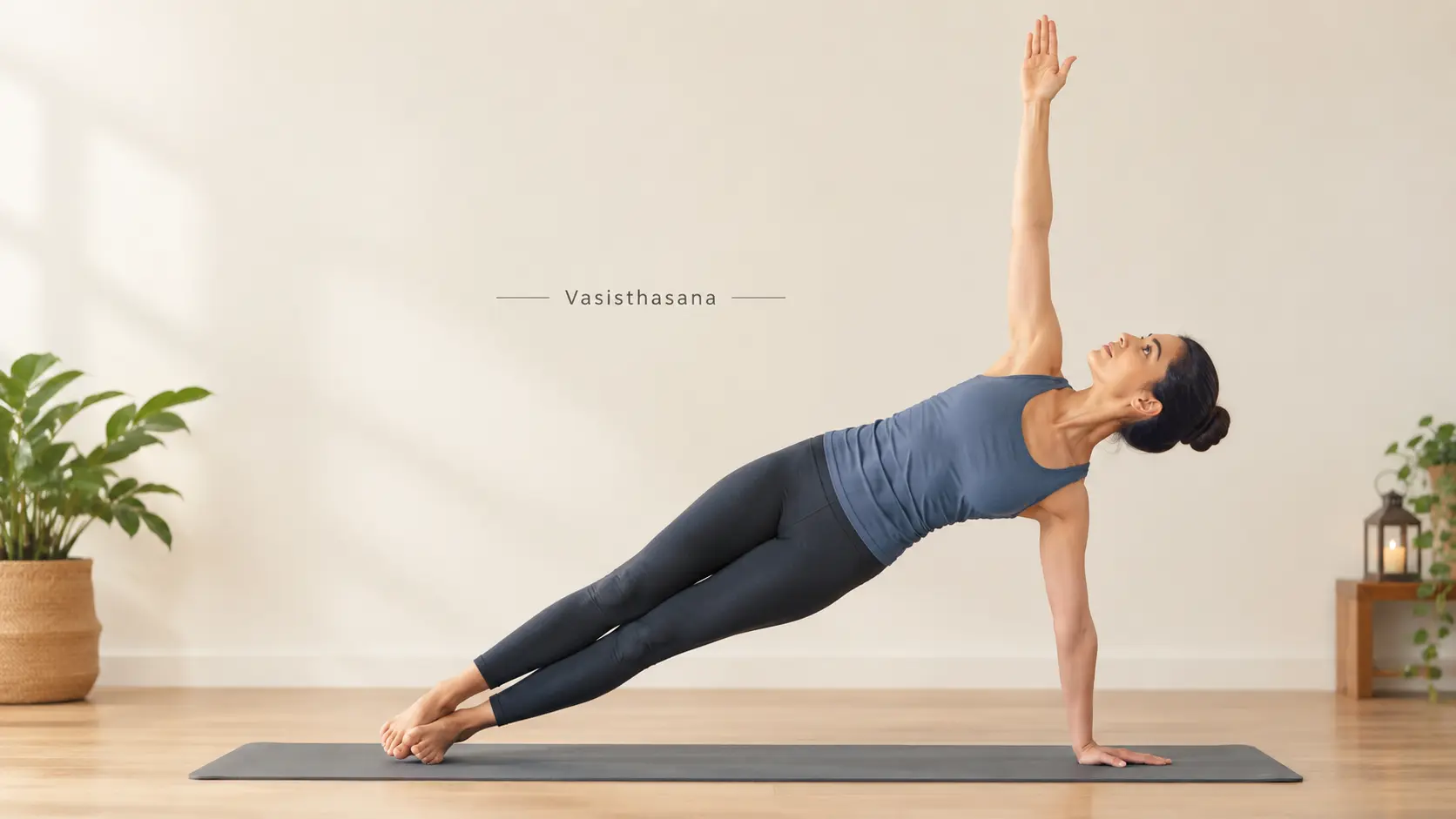
Vasisthasana (Side Plank Pose): Benefits
To practice Vasisthasana, or Side Plank Pose, is to engage in an exercise in empowerment and upper body strength, one that demands core strength and arm balance as well as focus of mind. Meaning “most excellent” or “wealthiest,” Vasisthasana is named for the great Vedic sage and challenges yogis to create a straight line from crown to heel while supporting themselves on one arm and the side of one foot.
Key Takeaways
- Lateral Core & Oblique Activation: Deeply strengthens the internal and external obliques, transverse abdominis, and quadratus lumborum.
- Shoulder Girdle & Wrist Stability: Builds weight-bearing stability across the serratus anterior, deltoids, and wrist flexor/extensor muscles.
- Balance & Body Alignment: Enhances proprioception and side-body integration by requiring precise stacked alignment of the shoulders, hips, and ankles.
Biomechanical Impact of Vasisthasana
Vasisthasana improves functional upper body and core health through targeted anatomical engagement:
- Scapular Stabilization: Weight bearing through one arm requires strong contraction of the serratus anterior and lower trapezius, preventing scapular winging and stabilizing the shoulder joint.
- Anti-Lateral Flexion Power: The lateral core muscles work isometrically over time against gravity to keep the pelvis lifted, preventing spinal sagging and supporting lower back health.
- Wrist and Forearm Fortification: Bearing body weight on a spread palm strengthens the carpal bones and surrounding tendons, improving joint resilience when practiced with correct alignment.
Variations of Vasisthasana (Side Plank Pose)
The following table details primary variations of Vasisthasana suited for different experience levels:
|
|
|
|
|
|
|
|
|
|
|
|
|
|
|
|
|
|
|
|
|
|
|
|
|
|
|
|
|
|
How to Perform Vasisthasana (Side Plank Pose)
Stacking your feet firmly in Vasisthasana activates the inner thighs and stabilizes the pelvis. Follow these steps:
- High Plank: Start by getting into a typical High Plank pose, with your hands directly under your shoulders, engaged core, and legs straight out behind you.
- Shift the Weight and Twist: Press your big toes together to touch; then twist onto the outside of your right foot, moving your body weight to your right hand.
- Stacking the Feet and Hips: Stack your left foot directly on top of your right foot (you can stagger your left foot in front of the right one for balance); engage your legs and flex your feet.
- Lift the Hips: Press your bottom hand down into the mat and raise your hips off the ground to create a strong diagonal line from your head to your heels.
- Top Arm Extension: Extend your top left arm upward toward the ceiling and stack your top shoulder over your bottom shoulder.
- Gaze and Hold: Maintain your head neutral or lift your head to look at your top thumb; hold for 20 to 40 seconds with deep breathing before switching sides.
Physical Complications and Injuries Prevented
Practising Vasisthasana regularly builds impressive isometric strength across the shoulders and obliques.
- Shoulder Impingement: Fortifies the rotator cuff and scapular stabilizers, keeping the head of the humerus securely centered in the shoulder socket.
- Lower Back Arching and Strain: Strengthens the deep lateral core muscles that protect the lumbar spine during daily lifting and twisting.
- Weak Wrist Mobility: Builds functional bone density and tendon resilience in the wrists and forearms.
- Poor Lateral Balance: Corrects muscular imbalances between the right and left sides of the body, improving overall athletic performance.
Precautions
Lowering the bottom knee to the mat makes Vasisthasana (Side Plank Pose) accessible to beginners building wrist stamina.
- Not Recommended for Acute Wrist or Shoulder Injuries: You should not use full bodyweight on the hand for people with injuries like rotator cuff tears, shoulder dislocation, or carpal tunnel syndrome.
- Keep Micro-Bend in Elbow Joint: Do not lock or overextend your elbow joint; use a micro-bend in it to activate the muscles in the area.
- Do Not Allow Hips to Drop Down: Dropping your hips down towards the floor will put extra pressure on the lumbar spine and shoulder joint; just bend your bottom knee when you get tired.
- Spread Body Weight in Whole Palm: Instead of putting all body weight onto the heel of your palm, distribute it equally across your palm by pressing through all five fingers and knuckles (Ghashi Mudra/active hand).
Build Strength, Confidence, and Balance
Adding Vasisthasana to your yoga practice is one of the most effective ways to develop physical strength and mental poise. Through practicing how to rise by engaging the hips and stacking the body properly, you transform a difficult test of strength into a beautiful pose. The Side Plank Pose, whether performed with the arm, supported knee, or in its classic alignment, strengthens you from within outwards.
Frequently Asked Questions (FAQs)
1. Which muscles are involved when performing Vasisthasana?
Vasisthasana is a yoga asana that works out the internal and external obliques, transverse abdominis, serratus anterior, deltoids, rotator cuff, gluteus medius, and wrist flexors/extensors.
2. What should I do if my wrists hurt while doing Vasisthasana?
You can opt for Forearm Vasisthasana by resting your supporting forearm flat on the mat (with your elbow stacked under your shoulder). In this way, you don't experience any wrist strain whatsoever yet receive exactly the same core and hip strengthening effects.
3. Which foot position is better in Side Plank Pose (feet stack or stagger)?
Stacked feet (with one placed on top of the other) involve more balancing effort and use of the core muscles. On the contrary, staggered feet (with one foot resting on the mat in front of the other) give more stability.
4. How can I prevent my hips from sagging in this asana?
Work on pressing your supporting hand into the mat while contracting your glutes and side-waist muscles. Visualization of a resistance band pulling your hips up can be helpful as well.
Disclaimer: The content on LifePositive.com, including articles/blogs on yoga, acupuncture, naturopathy, and other alternative healing modalities for holistic wellness, is for informational and educational purposes only. It is not a substitute for professional medical advice, diagnosis, or treatment. Always consult a qualified healthcare provider before starting any new health protocol or making changes to an existing treatment plan.
Also Read: Vyaghrasana
By Umesh Kumar Khiri

Discussion (0)
No comments yet. Be the first to comment!
Leave a Comment
You need to login to post a comment.