Yoga for Stiff Neck: Easy Poses
Practising yoga for stiff neck tension before bedtime can help relax your upper body and improve sleep quality.
Yoga for stiff neck is the most beneficial, natural way to relieve the tension that develops from sitting all day long in the office, improper sleep position, and a stressful life. The reason for chronic stiffness in the neck may be attributed to the tightness in the upper back and shoulder muscles and lack of flexibility in the cervical spine. Gentle yoga for stiff neck will help you to achieve decompression of the cervical spine, improved blood flow to tight muscles, and flexibility.
Key Takeaways
- Instant Muscle Relief: Daily practice of yoga for stiff neck decompresses tightness caused by poor posture and screen time.
- Simple & Gentle Poses: Accessible poses like Cat-Cow and Child's Pose restore full mobility without strain.
- Preventative Care: Spending just 5 to 10 minutes a day prevents tension buildup and reduces pain recurrence.
Benefits of Gentle Yoga for Stiffness
Neck tightness causes the muscles around it to tense and limit movement. The neck muscles are the trapezius, levator scapulae, and sternocleidomastoid muscles. Gentle yoga for stiff neck relief focuses on slow, controlled movements rather than deep or intense muscular strain.
Yoga works to:
- Lengthen Tight Muscles: By stretching taut fibers of the upper back and neck region to release tension.
- Increase Joint Range of Motion: To allow the rotation and bending movements of the spine, namely cervical and thoracic vertebrae.
- Improve Blood Flow: To bring oxygen-rich blood into the neck area to promote recovery.
Key Poses of Yoga for Stiff Neck
Many office workers find that spending five minutes doing yoga for stiff neck discomfort prevents chronic tension headaches. Some of the beneficial yoga poses are as follows:
|
|
|
|
|
|
|
|
|
|
|
|
|
|
|
|
|
|
|
|
|
|
|
|
Step-by-Step Instructions for Each Pose
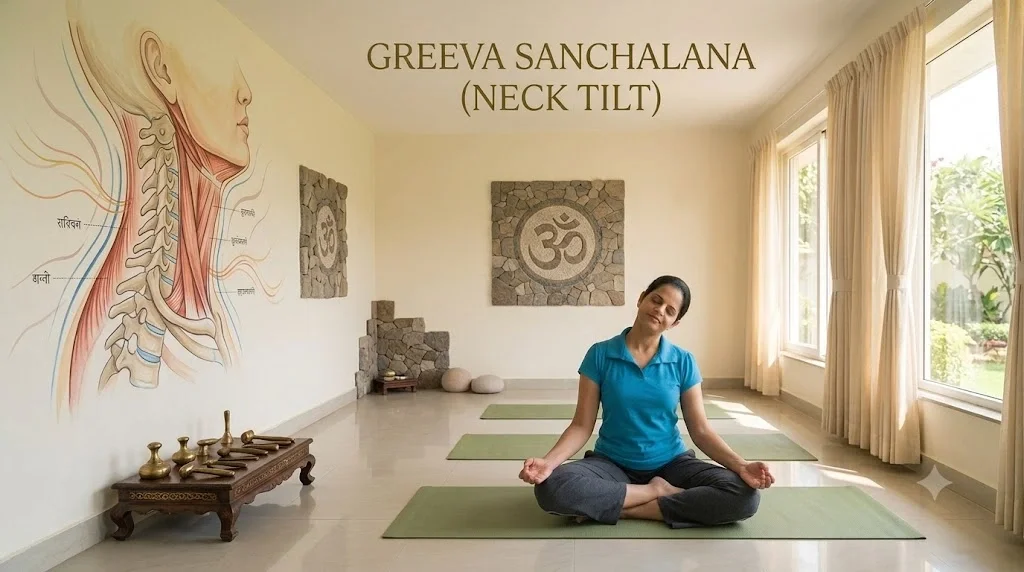
1. Neck Rolls & Tilts (Greeva Sanchalana)
- Step 1 (Setup): Sit comfortably with a tall spine and relax your shoulders away from your ears.
- Step 2 (Tilt Side): Exhale and slowly drop your right ear toward your right shoulder without lifting your shoulder.
- Step 3 (Tilt Center & Left): Inhale back to the center, then exhale and lower your left ear toward your left shoulder.
- Step 4 (Roll): Gently chin-roll your head forward in a half-circle from side to side for 5 slow breaths.
2. Cat-Cow Stretch (Marjaryasana-Bitilasana)
- Step 1 (Setup): Start on all fours with your wrists under your shoulders and knees under your hips.
- Step 2 (Cow): Inhale, drop your belly toward the mat, lift your chest, and look gently forward without crunching your neck.
- Step 3 (Cat): Exhale, arch your upper spine toward the ceiling, and gently tuck your chin to your chest.
- Step 4 (Flow): Continue moving fluidly between Cow on inhales and Cat on exhales for 5–8 breath cycles.
3. Thread the Needle (Parsva Balasana)
- Step 1 (Setup): Begin in a neutral tabletop position on your hands and knees.
- Step 2 (Reach): Inhale and extend your right arm out to the side or up toward the ceiling.
- Step 3 (Thread): Exhale and slide your right arm underneath your chest until your right shoulder and cheek rest on the floor.
- Step 4 (Hold & Switch): Take 5 deep breaths, press back up to tabletop, and repeat on the left side.
4. Extended Child’s Pose (Utthita Balasana)
- Step 1 (Setup): Kneel on the floor with your big toes touching and knees spread a comfortable distance apart.
- Step 2 (Fold): Exhale and hinge at your hips to fold forward, extending your arms long in front of you.
- Step 3 (Rest): Rest your forehead gently on the mat or on a yoga block to take all weight off your neck.
- Step 4 (Hold): Press your palms down, breathe deeply into your upper back, and hold for 1–2 minutes.
5. Corpse Pose with Neck Support (Savasana)
- Step 1 (Setup): Lie flat on your back, placing a thin rolled towel under the curve of your neck for support.
- Step 2 (Align): Rest your arms by your sides with palms facing up and allow your feet to turn out naturally.
- Step 3 (Relax): Close your eyes and consciously unclench your jaw, tongue, and throat muscles.
- Step 4 (Hold): Stay in deep, effortless breathing for 5 minutes to allow your neck muscles to completely release.
Wrapping Up
A stiff neck is a reminder for us to take our time and align ourselves. Using yoga poses and breathing exercises, we not only release our accumulated stress, but also establish a positive connection with our posture, both physically and psychologically. Yoga is not about forcing yourself through your pain but about making space, relaxing and moving fluidly. With regularity and gentleness, a more flexible neck and a relaxed mind will follow automatically.
Frequently Asked Questions
1. Is yoga a safe option for acute neck pain?
Movements such as head and neck tilts with support and Child's Pose are safe choices, but deep backbends and sudden movements must be avoided. Stop the movement if you experience sudden sharp pain.
2. How frequently should I do yoga in case of stiff neck?
It is recommended to practice neck stretches regularly for 5 to 10 minutes per day in order to prevent the buildup of tension due to desk work or stress. Beginners can easily start with neck stretches that require no special equipment.
3. Can yoga help with headaches that occur because of a stiff neck?
The answer is yes, because the release of tense muscles in the neck and back area is able to reduce the pressure of the suboccipital muscles, which cause tension headaches.
4. Which one, heat or ice, should I apply prior to yoga neck stretching?
A warm compress applied prior to your stretching will help to relax the tense muscle fibers.
Disclaimer: The content on LifePositive.com; including articles/blogs on yoga, acupuncture, naturopathy, and other alternative healing modalities for holistic wellness, is for informational and educational purposes only. It is not a substitute for professional medical advice, diagnosis, or treatment. Always consult a qualified healthcare provider before starting any new health protocol or making changes to an existing treatment plan.
Also Read: Yoga for Bloating
By Umesh Kumar Khiri



Discussion (0)
No comments yet. Be the first to comment!
Leave a Comment
You need to login to post a comment.