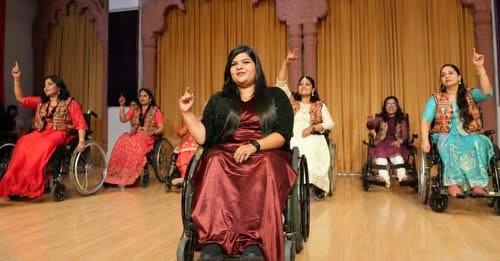
Dancing ably with joy and confidence
Priya Sharma originally from MP inspires us through never giving up on life. Her journey as shared with Jamuna Rangachari is given .below
1. What inspires you?
My inspiration has evolved through different phases of my life.
Growing up, my parents were my first role models. Their love, resilience, and unwavering belief in me taught me that every challenge can be faced with courage. However, the defining moment of my life came in September 2018, when a road accident resulted in a spinal cord injury and I became a wheelchair user. Suddenly, my life changed in ways I had never imagined. There were days when I questioned whether I would ever regain my confidence, independence, or sense of purpose. During that difficult period, my family stood firmly beside me, constantly reminding me that this setback would not define my future.
As I progressed through rehabilitation, I began discovering inspiring stories of people with disabilities who were leading independent and meaningful lives. Among them, Ekta Bhayan's journey had a profound impact on me. Her confidence, achievements, and advocacy helped me realise that a wheelchair is not a limitation—it is simply a different way of moving through life. She showed me that disability does not diminish our dreams, talents, or ability to create change.
Another turning point came when I entered para sports and connected with women with disabilities from different parts of India. Although our stories were different, we all shared similar experiences of social stigma, limited opportunities, and isolation. Instead of allowing these challenges to define us, we chose to move forward together. Their resilience became one of my greatest sources of inspiration.
These experiences eventually inspired me to establish Dance with Wheels. I chose dance because it is a universal language that goes beyond words. For many women with disabilities, dance is not merely an art form—it is a powerful expression of confidence, freedom, joy, and self-belief. Watching a participant who was once afraid to switch on her camera now perform confidently on stage reminds me why this journey is so meaningful.
Today, my inspiration comes from every woman who refuses to let disability define her identity, every family that believes in inclusion, and every individual who chooses courage over fear. Their strength reminds me every day that real change begins when we believe in ourselves and create opportunities for others to believe in themselves too.
2. Who supported you the most?
I have been fortunate to receive support from many people throughout my journey, and each has played an important role in shaping the person I am today.
My greatest support has always been my parents and family. Following my spinal cord injury, they stood beside me during one of the most challenging periods of my life. Their patience, encouragement, and unconditional belief gave me the strength to accept my new reality and rebuild my confidence. They never allowed me to see myself as helpless. Instead, they encouraged me to become as independent as possible and to continue pursuing my dreams.
I am deeply grateful to my doctors, physiotherapists, rehabilitation professionals, and peer mentors who guided me during my recovery. They helped me regain not only physical strength but also emotional resilience. Equally important was meeting other people living with spinal cord injuries. Seeing them lead fulfilling and independent lives gave me hope and helped me accept my own journey with confidence.
A special mention must go to Tarun Kumar, whose support has been invaluable in both my personal journey and the growth of Dance with Wheels. While he oversees operations, communications, documentation, partnerships, and event coordination for the organisation, he has also stood beside me through many personal and professional challenges. His encouragement, practical support, and unwavering belief in our mission have helped transform many ideas into meaningful action.
I have also found immense strength in the disability community. Fellow wheelchair users, para athletes, disability advocates, and the incredible women of Dance with Wheels inspire me every day. Although I founded the organisation with the hope of empowering others, I often feel that they have empowered me just as much. Watching women grow in confidence, perform proudly, and rediscover their potential is one of the greatest rewards of this journey.
Finally, I am sincerely thankful to every volunteer, trainer, donor, partner organisation, and well-wisher who has believed in our vision. Creating meaningful social change is never the work of one individual. It is the result of many compassionate people coming together with a shared purpose, and I remain deeply grateful to everyone who has walked this journey with us.
3. What challenges did you face and how did you overcome them?
The biggest challenge I faced began immediately after my road accident in September 2018, when I sustained a spinal cord injury and became a wheelchair user. Accepting that I would now live my life in a wheelchair was undoubtedly the hardest part of my journey. Like many people with a newly acquired disability, I struggled with uncertainty, fear, and countless questions about what my future would look like.
What helped me overcome this phase was the unwavering support of my family, my own determination to rebuild my life, and the guidance I received during rehabilitation. Meeting other people with spinal cord injuries was equally life-changing. Listening to their experiences and seeing them live independent, fulfilling lives gave me hope. They helped me understand that my wheelchair was not the end of my dreams—it was simply the beginning of a different journey.
Coming from a lower middle-class family in a small village near Chhindwara, Madhya Pradesh, brought additional challenges. Accessibility was limited, opportunities were scarce, and travelling long distances for rehabilitation, sports, or work was both difficult and expensive. My family made countless sacrifices to support my journey. Later, purchasing a car gave me greater independence and significantly reduced the challenges of travelling. For me, that car represented much more than transportation—it represented freedom.
Another challenge was becoming financially, physically, and emotionally independent. I never waited for the perfect opportunity. Instead, I accepted every opportunity that came my way. Some efforts were successful, while many were not. However, every setback taught me valuable lessons and strengthened my belief that persistence eventually creates new possibilities.
These personal experiences inspired me to establish Dance with Wheels because I realised that many women with disabilities were facing the very challenges I had once experienced—loneliness, lack of confidence, limited opportunities, and social isolation. I wanted to create a safe and empowering community where women could learn, express themselves, and grow together.
Building Dance with Wheels has brought its own challenges. Since many of our programmes are conducted online, several participants from rural areas struggle with poor internet connectivity, limited access to smartphones, or the lack of basic equipment. Rather than allowing these barriers to prevent participation, we look for practical solutions. Whenever possible, we provide mobile recharge support, tripods, and other essential resources, while also offering one-to-one guidance over phone calls to ensure no participant is left behind because of digital barriers.
As our community has grown, we have realised that empowerment extends far beyond dance. We continuously innovate to meet the diverse needs of women with disabilities. What began as online wheelchair dance sessions has now expanded into health and fitness programmes, offline events and workshops, community-building initiatives such as our Sunday Story Sharing Sessions, and an upcoming Digital Skills Programme designed to improve digital confidence and create future employment opportunities.
Financial sustainability remains one of our greatest challenges. At present, much of our work is sustained through our own personal contributions and the support of a few well-wishers while we continue building long-term partnerships and sustainable funding. As a registered charitable organisation with 12A and 80G certification, we are actively seeking support from individuals, CSR partners, foundations, and organisations that share our vision of inclusion and women's empowerment.
Looking back, I realise that every challenge has shaped the person I am today. My journey has taught me that obstacles do not disappear overnight, but with resilience, support, and a willingness to keep moving forward, they can become the foundation for creating meaningful change—not only in our own lives, but also in the lives of countless others.
4. What have been the most special moments in your life?
There have been many memorable moments in my journey, but the ones closest to my heart are not the awards or recognition I have received. They are the moments when I have seen hope return to someone's life.
One of the most special moments was regaining my own independence after my spinal cord injury. The day I realised that I could once again travel independently, participate in sports, work, drive my own car, and make decisions about my future, I understood that although disability had changed my life, it had not taken away my dreams. That realisation completely changed my perspective and gave me a renewed purpose.
Another unforgettable milestone was founding Dance with Wheels. What began as a small online initiative with just a handful of women has gradually grown into a supportive community connecting women with disabilities from different states across India. Every participant has a unique story, yet they share a common determination to live with confidence and dignity.
One of the most emotional milestones was organising our first national offline event, Astitva – The Dance of Identity. Seeing women travel from different parts of the country—many of them travelling independently for the first time—and watching them perform confidently on stage was an experience I will never forget. Some participants had never imagined themselves performing before a live audience. Seeing their families applaud them with pride, and witnessing the joy, confidence, and friendships that emerged during those few days, made every challenge behind organising the event worthwhile.
I also treasure the quieter moments that rarely make headlines. When a participant tells me that she no longer feels isolated, when a parent shares that their daughter has become more confident after joining our sessions, or when a woman who was once afraid to speak now shares her story publicly, those moments remind me why this work matters.
Success, for me, is not measured by trophies or titles. It is measured by lives transformed, confidence restored, and dreams rediscovered. Every smile, every performance, every new friendship, and every small step towards independence reminds me that meaningful change often begins with simple acts of encouragement.
Looking back, I realise that my most special moments have always been connected to people. Every time someone discovers confidence, independence, or a renewed sense of purpose through our work, I feel that my own journey has found a deeper meaning. Those are the moments I will always cherish.
5. What is your vision?
My vision is to build a society where disability is never a barrier to living with dignity, confidence, equal opportunity, and the freedom to dream. I want every woman with a disability to have access to education, employment, healthcare, sports, arts, leadership opportunities, and an inclusive environment where her abilities are recognised and celebrated.
Through Dance with Wheels, my dream is to build India's largest and most inclusive community of women with disabilities. Although our journey began with wheelchair dance, our mission goes far beyond dance. We are creating a platform that empowers women through physical fitness, digital skills, community building, leadership development, confidence, and greater social and economic independence.
One of my biggest aspirations is to see Para Dance Sport receive the recognition it deserves in India. Internationally, wheelchair dance is recognised as a competitive sport, providing athletes with disabilities the opportunity to compete through World Para Dance Sport competitions. I dream of seeing talented Indian wheelchair dancers receive professional coaching, participate in national championships, proudly represent India at international competitions, and inspire future generations of athletes.
At present, India does not yet have a well-established national ecosystem dedicated to the development and promotion of Para Dance Sport. One of my long-term goals is to contribute towards building that ecosystem by bringing together athletes, coaches, dance professionals, disability organisations, sports authorities, and policymakers. I hope that together we can create structured pathways for talent identification, coaching, competitions, classification, and international participation so that wheelchair dancers in India receive opportunities equal to those available in many other countries.
Alongside this, Dance with Wheels will continue expanding its programmes beyond dance. We are strengthening initiatives in health and fitness, digital skills, community building, offline workshops, and leadership development so that women with disabilities receive holistic support to lead confident, independent, and fulfilling lives.
Another important part of my vision is changing society's mindset. Accessibility is essential, but true inclusion begins when society recognises persons with disabilities as artists, athletes, professionals, entrepreneurs, leaders, and changemakers—not as individuals defined by their limitations. I hope to replace sympathy with respect, dependence with opportunity, and barriers with possibilities.
Ultimately, I want Dance with Wheels to become more than an organisation—I want it to become a national movement that transforms lives, creates opportunities, and inspires inclusion. If one woman's courage encourages another woman to believe in herself, and that confidence continues to spread from one life to another, then together we can create lasting social change. That is the future I dream of and the mission I will continue working towards every single day.
6. What would you like to share with others?
If there is one message I would like to share, it is this: life may change unexpectedly, but our ability to find purpose, hope, and happiness always remains within us.
After my spinal cord injury, I never imagined that one day I would be leading an organisation dedicated to empowering women with disabilities. Looking back today, I realise that some of life's greatest opportunities emerge from the most difficult experiences—if we choose not to give up.
To every person living with a disability, I want to say: never underestimate yourself. Your disability is only one part of your life; it does not define who you are or what you can become. Progress may be slow, and there will be days when you feel discouraged, but every small step matters. Celebrate your achievements, continue learning, seek support when you need it, and never stop believing in your own abilities.
I also want to share a message with families. Your encouragement has the power to transform lives. When you support a family member with a disability to become independent, pursue education, travel, play sports, build a career, or follow a passion, you give them confidence that no physical aid can replace. My own journey would not have been possible without the unconditional support of my family.
To society, I would like to say that persons with disabilities do not seek sympathy—we seek opportunity, accessibility, and equal participation. Inclusion is not about doing us a favour; it is about recognising every individual's right to contribute and belong. When society focuses on ability instead of disability, everyone benefits.
Finally, I encourage people to become partners in creating an inclusive society. Whether you are an individual, educator, healthcare professional, employer, volunteer, donor, policymaker, or corporate leader, you have the power to create opportunities that can change someone's life. Sometimes the smallest act of encouragement can become the beginning of someone's biggest transformation.
When I started Dance with Wheels, it was simply a dream to create a safe and empowering space for women with disabilities. Today, that dream is growing because many people have believed in it and contributed in their own ways. I truly believe that meaningful change is never created by one person alone—it is created when a community comes together with compassion, respect, and a shared vision.
Above all, I hope every reader remembers one simple truth: our greatest limitations are often not physical—they are the limits we place on our own minds. The moment we choose courage over fear, possibilities begin to unfold.
7. Are you happy with the path you have chosen?
Absolutely, yes.
This journey has not been easy, and I would never pretend that it has been. There have been moments of physical pain, emotional struggles, financial uncertainty, and many obstacles that tested my patience and determination. If someone had asked me immediately after my spinal cord injury whether I could imagine the life I am living today, my answer would probably have been "no." At that time, I was simply trying to accept my new reality.
Today, when I look back, I realise that every challenge has shaped the person I have become. My disability changed the direction of my life, but it also gave me something I had never expected—a deeper purpose. It taught me resilience, empathy, gratitude, and the importance of creating opportunities for others rather than waiting for opportunities to come to me.
The greatest happiness in my life does not come from personal achievements. It comes from witnessing transformation in others. When I see a participant who once lacked confidence perform proudly on stage, travel independently, learn a new skill, or smile because she finally feels accepted and valued, I know that every struggle has been worthwhile. Those moments remind me that real success is measured not by awards, but by the lives we are able to touch.
There is still a long journey ahead. Dance with Wheels continues to grow, and with that growth come new responsibilities and new challenges. We want to reach more women, develop new programmes, strengthen Para Dance Sport in India, create international opportunities, and build a future where women with disabilities have every opportunity to thrive. While the road ahead is long, it fills me with excitement rather than fear because I know our mission has the power to create lasting change.
If my journey has taught me one lesson, it is this: sometimes life does not give us the path we planned, but it gives us the path we are meant to create. I never chose to become a wheelchair user, but I chose not to let that define my future. Instead, I chose to transform my experience into a mission that empowers others.
So yes, I am truly happy with the path I have chosen—not because it has been easy, but because it has been meaningful. Every challenge has strengthened me, every setback has taught me something valuable, and every life touched through Dance with Wheels reminds me that purpose is life's greatest achievement.
My journey is still unfolding, and I hope that many years from now, when people look at Dance with Wheels, they will not simply see an organisation. They will see a movement that gave thousands of women with disabilities the confidence to believe in themselves and the opportunity to dance, dream, and live without limits.
By Jamuna Rangachari

Discussion (0)
No comments yet. Be the first to comment!
Leave a Comment
You need to login to post a comment.