Restoring Harmony: The Power of Ancient Hawaiian Healing
Introduction: Understanding the Foundations of Inner Reconciliation
Ho'oponopono is a Hawaiian practice traditionally associated with reconciliation, restoring harmony, and resolving conflict within families and communities. In modern wellness culture, Ho'oponopono is frequently practiced as an inward exercise. These statements are often used as a meditation focused on forgiveness, acceptance, gratitude, and compassion. This modern practice can be meaningful for some people and restore peace in their lives through forgiveness, understanding, and love.
At its heart, the contemporary practice encourages people to examine their thoughts, emotions, memories, and relationships rather than continually placing responsibility for their inner experience outside themselves. This does not mean accepting blame for everything that happens. Instead, it can mean acknowledging one's own reactions, choices, assumptions, unresolved emotions, and contributions to difficult situations.
The appeal of Ho'oponopono lies partly in its simplicity. Repeating a short set of phrases can provide a structured way to pause, breathe, reflect, and release resentment. When practiced thoughtfully, it may complement meditation, journaling, counseling, or other approaches to emotional well-being. It is best understood as a spiritual or reflective practice rather than a substitute for professional medical or mental-health treatment.
Ho'oponopono Practices for Emotional Clearing
The spelling most commonly used for the practice is Ho'oponopono. Emotional clearing in its modern interpretation involves consciously bringing difficult feelings into awareness and responding to them with responsibility, forgiveness, gratitude, and compassion. Rather than suppressing anger, sadness, guilt, or fear, practitioners may use meditation to observe these emotions without immediately acting upon them.
This process can be especially valuable when emotional reactions have become repetitive. A disagreement that happened years ago may continue to influence how someone approaches a relationship. A painful memory may create a habit of defensiveness. A mistake may produce persistent self-criticism. Reflective practices such as Ho'oponopono can create a moment in which these patterns are noticed rather than automatically repeated.
Emotional clearing should not be interpreted as magically erasing memories. Healing generally does not require forgetting what happened. Instead, it can involve changing the relationship a person has with the memory. The event remains part of one's history, but it may no longer control every present reaction.
Reciting Mantra Phrases for Self-Forgiveness
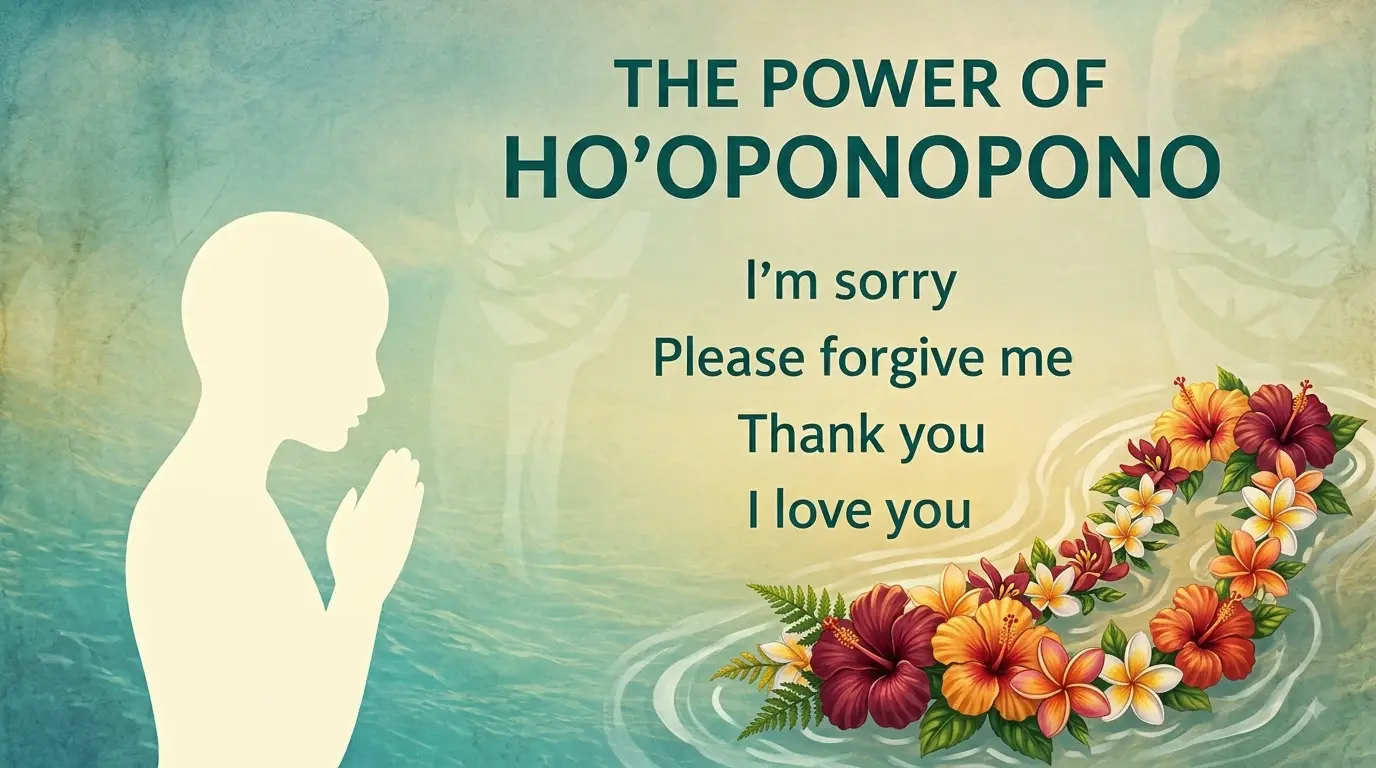
The four phrases commonly associated with modern Ho'oponopono are:
I am sorry.
Please forgive me.
Thank you.
I love you.
Practitioners may repeat these phrases silently or aloud during meditation. They can be directed toward oneself, a relationship, a painful memory, or a spiritual understanding of life.
"I am sorry" can represent acknowledgment. It may invite a person to recognize that something within their thoughts, behavior, or emotional response needs attention. The phrase does not necessarily mean accepting responsibility for another person's harmful actions.
"Please forgive me" can symbolize a willingness to release guilt, resentment, or attachment to past mistakes. Self-forgiveness is particularly important because people can sometimes remain trapped in cycles of punishment long after they have learned from an experience.
"Thank you" introduces gratitude. Gratitude does not require someone to be grateful for suffering or mistreatment. Instead, it can focus attention on present resources, lessons, supportive relationships, or the simple opportunity to begin again.
"I love you" expresses compassion and acceptance. For some practitioners, this is directed toward themselves; for others, toward another person, their spiritual tradition, or life itself.
The phrases become most meaningful when they are accompanied by genuine reflection. Repeating words mechanically may provide temporary calm, but deeper change often requires understanding the emotions behind them and making appropriate changes in behavior.
Clearing Negative Energy and Unconscious Karma
Modern descriptions of Ho'oponopono sometimes refer to clearing "negative energy," subconscious memories, or unconscious karma. These ideas are interpreted differently across spiritual traditions and should not be presented as scientifically established mechanisms.
Within a personal spiritual framework, however, such language can describe the experience of carrying unresolved emotional patterns. A person might repeatedly expect rejection, replay an argument, feel shame about a previous mistake, or react strongly to situations that resemble an earlier painful experience. These patterns can feel as though they are operating automatically.
Meditative repetition provides an opportunity to notice such patterns. Instead of immediately believing every thought, the practitioner can observe it and ask: What am I feeling? What assumption am I making? What part of this situation belongs to the past? What can I take responsibility for now? What can I release?
This distinction is important. Emotional responsibility should not become excessive self-blame. A person who has been harmed by another individual is not responsible for the other person's abusive or unethical behavior. Forgiveness also does not require returning to an unsafe relationship.
In this sense, emotional clearing is most constructive when paired with discernment. One can release resentment while maintaining boundaries. One can forgive oneself while still acknowledging consequences. One can seek peace without pretending that an injustice never occurred.
Cultivating Personal Responsibility and Spiritual Healing
Personal responsibility is one of the most useful ideas that modern practitioners can take from a reconciliation-oriented approach. Taking responsibility means examining one's own choices and responses honestly.
For example, after an argument, a person may recognize that the other individual behaved unfairly while also acknowledging that they responded with unnecessary anger. Both realities can exist simultaneously. Personal responsibility allows someone to apologize for their own actions without taking ownership of another person's actions.
Spiritual healing can also involve making practical changes. If a person repeatedly damages relationships through harsh communication, repeating a mantra alone may not be sufficient. They may need to learn communication skills, practice patience, establish healthier boundaries, or seek counseling.
Similarly, self-forgiveness should not become an excuse to avoid accountability. Genuine reconciliation often involves acknowledging harm, making amends where appropriate, and changing behavior. The spiritual dimension can support these actions by encouraging humility and compassion.
Transformative Health and Well-Being Outcomes
People who practice modern Ho'oponopono often describe benefits such as greater calm, emotional clarity, improved relationships, and increased self-compassion. These experiences may arise partly from the broader psychological benefits associated with meditation, intentional reflection, gratitude, and forgiveness.
However, Ho'oponopono should not be described as a guaranteed treatment for disease or as a replacement for medical care. There is a meaningful difference between saying that a contemplative practice may support emotional well-being and claiming that it can cure a physical or psychological illness.
Its potential value is therefore best considered within a broader approach to health. Sleep, nutrition, exercise, social connection, professional healthcare, psychological support, and spiritual practice can all contribute to well-being.
Achieving Mental Peace through Stress Reduction
Modern life frequently encourages continuous stimulation. People move between work, family responsibilities, digital communication, financial concerns, and personal expectations with little time for reflection. A short contemplative practice can create a deliberate pause.
Ho'oponopono meditation may involve sitting quietly, breathing slowly, and repeating the four phrases while allowing thoughts and feelings to arise. The repetition gives the mind a simple point of focus.
When stressful thoughts appear, practitioners can acknowledge them without immediately following every thought into another chain of worry. The practice can therefore function similarly to other forms of mindful reflection: it creates space between an emotional stimulus and an automatic response.
The greatest benefit may come not from the words themselves but from the attitude cultivated while using them. Compassion can soften harsh self-talk. Gratitude can redirect attention toward what remains supportive. Forgiveness can reduce the desire to repeatedly revisit old conflicts.
Resolving Interpersonal Conflict and Relationship Healing
Reconciliation is particularly relevant to relationships because unresolved conflict can influence families, friendships, marriages, workplaces, and communities.
A person practicing Ho'oponopono may begin by examining their own contribution to a conflict. Did they communicate clearly? Did they listen? Did they make assumptions? Did they apologize when appropriate? Did they continue an argument because they wanted to win rather than understand?
This type of reflection can improve the quality of a future conversation. However, reconciliation should involve mutual willingness when another person is directly involved. An individual cannot use a spiritual practice to force another person to forgive them.
Healthy reconciliation may include an honest apology, listening without defensiveness, acknowledging the other person's experience, and agreeing on practical changes. In some situations, reconciliation may not be appropriate. Maintaining distance or firm boundaries can be the healthiest choice.
Thus, relationship healing is not always about restoring the relationship to its previous form. Sometimes healing means creating a healthier relationship; sometimes it means accepting that a relationship must change.
Fostering Self-Love and Emotional Balance
Self-love is often misunderstood as constant positive thinking. Genuine self-love can be more demanding. It involves recognizing one's strengths and limitations without reducing one's identity to mistakes or failures.
The phrase "I love you" can be used during meditation as a reminder that personal worth does not disappear because of an error. At the same time, self-compassion should coexist with accountability.
Emotional balance does not mean being happy all the time. Human beings naturally experience anger, grief, disappointment, fear, excitement, and joy. Balance means developing the capacity to experience emotions without allowing every emotion to dictate behavior.
A consistent contemplative routine can encourage this balance. Five or ten quiet minutes each day may provide enough space to recognize what is happening internally. Journaling afterward can deepen the process by turning vague feelings into specific observations.
Finding a Qualified Spiritual Practitioner
Someone interested in experiencing Ho'oponopono with a practitioner should approach the process thoughtfully. Because the practice has become popular internationally, many people now use the name Ho'oponopono for different forms of spiritual coaching, energy healing, meditation, and personal development.
A practitioner should be transparent about what they actually offer. They should not claim that a spiritual session can guarantee the cure of cancer, eliminate every mental-health condition, replace prescribed treatment, or produce supernatural results on demand.
It is also worthwhile to ask whether a practitioner is teaching a contemporary adaptation or presenting their work as traditional Hawaiian Ho'oponopono. Cultural context matters. A responsible facilitator should be willing to explain the origins and limitations of the approach rather than presenting a simplified modern technique as though it represents all Hawaiian traditions.
Verifying Experience of Energy Healing Facilitators
Experience and testimonials can provide useful information, but they are not proof that a treatment is medically effective.
A responsible practitioner should respect confidentiality and personal autonomy. They should not pressure clients into expensive packages, discourage them from seeing doctors or therapists, or suggest that illness is simply the result of insufficient spiritual practice.
Questions worth asking include: What training have you completed? How do you describe your approach? What happens during a session? What are your fees? Are there situations in which you recommend professional medical or psychological support?
It is also important to recognize that "energy healing" is a broad spiritual term rather than a single scientifically established medical treatment. Someone may choose it as a complementary spiritual experience while continuing evidence-based healthcare.
Integrating Mindful Meditation into Daily Life
Ho'oponopono can become more useful when integrated into ordinary life rather than treated solely as a special ceremony.
A simple routine might begin with several slow breaths. After settling, a person can bring attention to a particular concern and repeat the four phrases slowly. Instead of forcing an emotional reaction, they can simply notice what arises.
For example:
Morning: Spend five minutes setting an intention for compassion and patience.
During conflict: Pause before responding and silently repeat one or more phrases.
Evening: Reflect on an interaction that caused tension and consider what can be learned.
Before sleep: Practice gratitude and release the need to solve every problem immediately.
The purpose is not perfection. Some days may feel peaceful; other days may bring difficult emotions. Consistency matters more than intensity.
Beginning Your Spiritual Transformation Journey
Beginning a spiritual practice does not require dramatic changes. Transformation often develops through small, repeated acts of awareness. Ho'oponopono can serve as one framework for developing greater responsibility, forgiveness, gratitude, and compassion.
It is helpful to approach the practice with realistic expectations. The goal does not need to be instant emotional cleansing. Instead, the journey can involve gradually becoming more aware of internal patterns and responding to them differently.
Someone struggling with serious depression, trauma, anxiety, addiction, or other significant difficulties should consider professional support. Spiritual practices can complement appropriate care, but they should not be used to delay necessary treatment.
A thoughtful approach also respects Hawaiian culture. Learning about the cultural background of Ho'oponopono helps prevent the practice from being reduced to a fashionable collection of positive affirmations. Its broader context is concerned with relationships, reconciliation, responsibility, and restoration of harmony.
Preparing for Your First Healing Session
Before attending a session, take time to identify what you hope to explore. You might write down a relationship that feels unresolved, a recurring emotional pattern, or an area in which you want to practice self-forgiveness.
Avoid the expectation that another person will "fix" you. A practitioner, meditation teacher, or spiritual guide can provide structure, but meaningful change ultimately involves your own participation.
During a session, you should feel free to ask questions and stop if something feels inappropriate or unsafe. You do not need to disclose personal information that you are uncomfortable sharing.
Afterward, give yourself time to reflect. Some experiences may feel immediately peaceful, while others may bring memories or emotions that require additional attention. Journaling, quiet reflection, or speaking with a qualified counselor can help process those experiences.
Booking Your Personal Energy Healing Consultation
If you decide to book a consultation, choose a practitioner based on transparency and appropriate boundaries rather than promises of miraculous results. Confirm the session length, price, cancellation policy, and nature of the service beforehand.
A good consultation should support your autonomy. You should never feel pressured to purchase additional sessions or accept claims that make you afraid of what will happen if you stop treatment.
The most constructive way to approach Ho'oponopono is as an opportunity for reflection and reconciliation. Its modern four-phrase meditation can encourage people to pause, acknowledge their feelings, practice forgiveness, express gratitude, and reconnect with compassion. Its traditional cultural context, however, is richer than a simple mantra and deserves to be treated with respect.
Ultimately, the power of reconciliation lies not merely in repeating words but in allowing those words to inspire meaningful action. Saying "I am sorry" can lead to accountability. "Please forgive me" can open the door to humility. "Thank you" can cultivate appreciation. "I love you" can encourage compassion.
Whether practiced privately as meditation or explored within a culturally informed spiritual setting, these principles can invite a person to examine how they relate to themselves and others. Healing does not necessarily mean erasing the past. It can mean learning from it and releasing what is not necessary.
In that sense, the enduring appeal of Ho'oponopono is its emphasis on harmony. True harmony is not the absence of difficulty. It is the capacity to meet difficulty with honesty, responsibility, compassion, and a willingness to restore balance wherever possible.
We hope this practice restores harmony and peace in our lives.
By Jamuna Rangachari



Discussion (0)
No comments yet. Be the first to comment!
Leave a Comment
You need to login to post a comment.