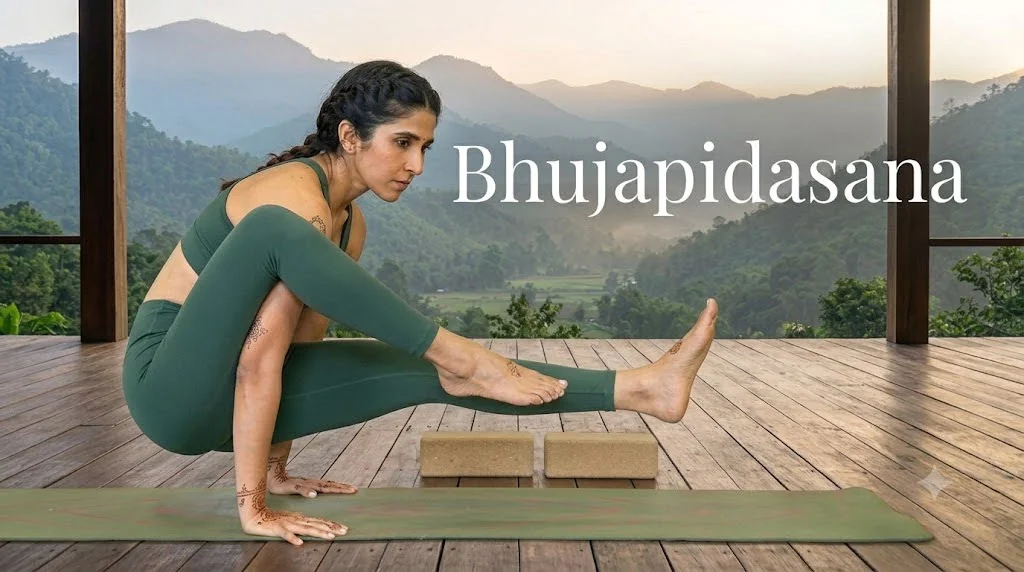
Bhujapidasana: Shoulder-Pressing Pose
Bhujapidasana, or the Shoulder-Pressing Pose, is one of the most difficult arm-balance asanas that requires the practitioner to balance himself on the hands with the legs wrapped around the arms. The practice of yoga does not involve just stretching but the accomplishment of difficult physical postures. Some asanas demand that practitioners combine the skills of strength, flexibility, balance, and concentration.
Due to the complexity of this posture, it is more appropriate for those practitioners who have gained some experience in yoga. Preparations can contribute to building up the necessary strength and flexibility to perform the asana more effectively. Instead of attempting to do it at once, practitioners need to pay attention to gaining stability and even breathing.
Key Takeaways
- Builds upper-body and wrist strength through arm balancing.
- Engages core muscles to keep legs elevated.
- Challenges balance, coordination, and deep focus.
What Is Bhujapidasana (Shoulder Pressing Pose)?
Bhujapidasana is derived from the Sanskrit language, where Bhuja means arm, Pida means pressure, and Asana means posture. It signifies the posture adopted when doing this yoga move, whereby the thighs press against the upper arms and the hands are placed under the body.
In this position, the person adopts a low squat position and then places their hands on the ground before bringing the legs around the upper arms and lifting the legs.
This position is normally regarded as an advanced arm balance position due to the strength needed to sustain the position.
How to Perform Bhujapidasana (Shoulder Pressing Pose)
Follow the movement gradually rather than trying to lift the body abruptly.
- Start by assuming a comfortable squat position with the feet placed fairly close to each other.
- Slightly bend the trunk and create space between the thighs.
- Firmly place the hands on the floor while ensuring that they are placed at shoulder-width apart.
- Push the upper arms under the thighs.
- Raise the thighs up around the upper arms as much as possible.
- Extend the fingers and find your base through the palms.
- Engage the core muscles and move the center of gravity forward.
- Lift the feet off the floor gradually and one after another.
- Once stabilized, cross the ankles.
- Continue breathing normally without moving your head.
- Maintain the posture only for as long as you can stay in control.
- Lower the feet gradually back to the starting squat.
- Do not jump into the posture. Entering and exiting it are equally important as assuming the final pose.
Benefits of Bhujapidasana
The following are some of the benefits of practising Bhujapidasana daily:
|
|
|
|
|
|
|
|
|
|
|
|
|
|
|
|
|
|
|
|
|
Preparation for Bhujapidasana
Doing the full arm balance at once is not advisable. Preparatory actions may be helpful to build the necessary strength and flexibility.
Suggestions for inclusion include:
- Malasana/Garland Pose
- Planks
- Chaturanga actions
- Gentle wrist conditioning
- Core strengthening
- Hip opening stretches
- Easy arm balances according to your level
Make sure that enough warm-up of the wrists, shoulders, hips, and core takes place before practicing the pose.
Precautions
Remember the following while practising the Shoulder Pressing Pose:
- Joint protection: The posture involves putting pressure on the hands, wrists, arms, and shoulders. Therefore, one should practice with the right alignment.
- Avoiding any injury: One should refrain from doing the posture in case one has injuries to the wrists, elbows, shoulders, knees, hips, neck, or lower back unless instructed otherwise by a professional.
- Individual advice: In case one has any medical conditions that can be influenced by advanced arm balances, it is advisable to seek professional advice.
- Pregnancy: It is advised not to do Bhujapidasana when pregnant because of the need for balance and abdominal pressure.
- Do not push yourself: One should go slow while doing the pose and not put pressure on their body.
- Stop in case of problems: In case one feels sharp pain, numbness, dizziness, or any other discomfort, one should stop.
- Under professional guidance: It is advisable to do the pose under the guidance of an experienced yoga instructor.
Final Thoughts
Bhujapidasana is a demanding yoga pose that combines upper body strength, core control, hip flexibility, balance, and concentration. As such, progressive development becomes all the more crucial due to the complexity of this pose. Rather than timing the pose in order to gauge proficiency in Bhujapidasana, concentrate on learning how to perform it with proper alignment and breathing. The therapeutic effects of Bhujapidasana provide great results over time.
FAQs
1. Is Bhujapidasana a good pose for beginners?
The entire pose may prove difficult for beginners. It would be wise to work towards strengthening the wrist, shoulders, core, and hips with other exercises and yoga postures.
2. Why am I unable to lift my feet in Bhujapidasana?
Your inability to lift the feet could be due to a lack of hip flexibility, core/upper body strength, or the inability to shift body weight forwards. Perform the preparation poses instead of forcing yourself to lift.
3. How long should I stay in Bhujapidasana?
Try staying for a short time at first so as to ensure control and breath stability. With time, you can try increasing the duration.
4. What should I concentrate on while performing Bhujapidasana?
Concentrate on strong palm placement, core activation, controlled weight shifting, breathing, and steady gaze.
Disclaimer: The content on LifePositive.com, including articles/blogs on yoga, acupuncture, naturopathy, and other alternative healing modalities for holistic wellness, is for informational and educational purposes only. It is not a substitute for professional medical advice, diagnosis, or treatment. Always consult a qualified healthcare provider before starting any new health protocol or making changes to an existing treatment plan.
Also Read: Virasana
By Umesh Kumar Khiri

Discussion (0)
No comments yet. Be the first to comment!
Leave a Comment
You need to login to post a comment.