Biosphere Nature Pools Is Reminding India That Water Is Supposed to Stay Alive
India has one of the oldest and most profound relationships with water of any civilisation on earth. The Vedic scriptures describe rivers as living goddesses. Ganga Jal, drawn from the Ganges, holds sacred status in Hindu ritual because the water is understood to be alive. Researchers studying Ganga water have since confirmed what ancient wisdom carried intuitively: the river contains unique bacteriophages, natural organisms that destroy harmful bacteria, giving it genuine self-purifying properties that keep it functional without chemical intervention. For thousands of years, the Indian understanding of water rested on one premise. Water that is alive sustains everything around it.
Then the modern swimming pool arrived. With it came a different premise entirely: that water is safest, cleanest, and most desirable when nothing biological can survive in it.
India's per capita water availability is projected to drop to 1,367 cubic metres by 2031, well below the international water stress threshold of 1,700 cubic metres. The World Economic Forum's 2025 Global Risks Report identified India as one of five countries where the water supply crisis ranks as the top immediate national risk. Into this landscape, hundreds of thousands of litres of chemically treated pool water are discharged into drainage systems every year across Indian homes, because chlorine and pool chemicals can leach into surrounding soil and groundwater, contaminating local water sources and posing threats to aquatic life. This water cannot touch a garden, irrigate a crop, or re-enter any natural system without causing harm. It simply goes to waste.
The Water That Never Leaves
A Biosphere pool divides into a swim zone and a regeneration zone, where aquatic plants and beneficial bacteria clean the water continuously. No chemicals enter the system at any stage. No annual draining follows. The water stays in place, circulating through living biology, becoming more ecologically stable with each passing season.
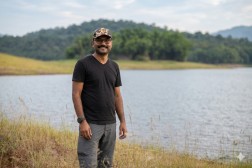
Kumar's own pond at his Pollachi farmhouse has been running for four and a half years without being emptied. When the water does leave a Biosphere system for any reason, it can go directly onto food crops. Nothing in it harms the soil. Conventional pool water, by contrast, must be sent to drainage because putting it anywhere near plants or soil would kill them.
The average conventional pool loses between 57,000 and 190,000 litres annually to evaporation and backwashing, and requires complete draining on a cycle of one to four years. In a country already facing water stress, every one of those drain cycles sends chemically saturated water permanently out of any usable system. A Biosphere pool removes that cycle entirely.
Materials That Nobody Wanted
The construction model compounds the environmental case. No cement and no steel go into a Biosphere build. The structural material is rock, and the rocks Biosphere uses are the ones that quarries and highway construction projects set aside and abandon. Top-layer quarry stone that no commercial operator wants. Waste rock is cleared from road projects and left at roadsides. Kumar's standard instruction to clients is to bring him the stones sitting unused at the edges of their land.
The result is a luxury water feature built almost entirely from discarded materials, held together by a drinking-water-safe rubber liner, and run on German-engineered low-energy pumps that consume less than one-tenth of the electricity an equivalent Indian pump would draw. The environmental footprint of the build itself is as close to zero as any constructed water feature can get.
The Ecosystem That Returns
The dimension of Biosphere's work that takes the longest to appreciate is also the most significant. A natural pool does not just reduce harm. It restores something that was displaced.
Dragonflies arrive at a Biosphere pond because the ecosystem invites them. They are among the most effective natural mosquito predators, and their presence actively reduces mosquito populations in the surrounding area. Native fish species are introduced and thrive. At Kumar's own pond in Pollachi, mud crabs arrived without any introduction, found conditions hospitable, and stayed. Eight or nine varieties of native fish now share the water with his family.
A small living water body, managed well, does what India's rivers have always done when left to function. It draws life in, filters itself through that life, and gives back to the land around it.
The ancient instinct that treated water as sacred was pointing at something precise. Water that carries a functioning biology purifies itself. The bacteriophages in Ganga water, the plants in a regeneration zone, the beneficial bacteria in a well-balanced natural pond — the mechanism differs, but the principle is the same. Living water maintains itself. Dead water asks for constant intervention and leaves damage when it finally goes.
Biosphere Nature Pools is building a business on a distinction that India understood long before the swimming pool existed. In a country running short of fresh water, that distinction is not a philosophy. It is an engineering imperative.
About the author:
Vikash Kumar M is the Founder and Creative Head of Biosphere Nature Pools LLP, a company pioneering natural, chemical-free swimming pools in India. A former Chartered Accountant, he transitioned into ecological water design after years of global research and hands-on experimentation in natural filtration systems. Combining technical expertise with a deep understanding of landscapes and sustainability, Vikash is driving a shift towards biologically alive, environmentally responsible water bodies in the luxury segment.


Discussion (0)
No comments yet. Be the first to comment!
Leave a Comment
You need to login to post a comment.