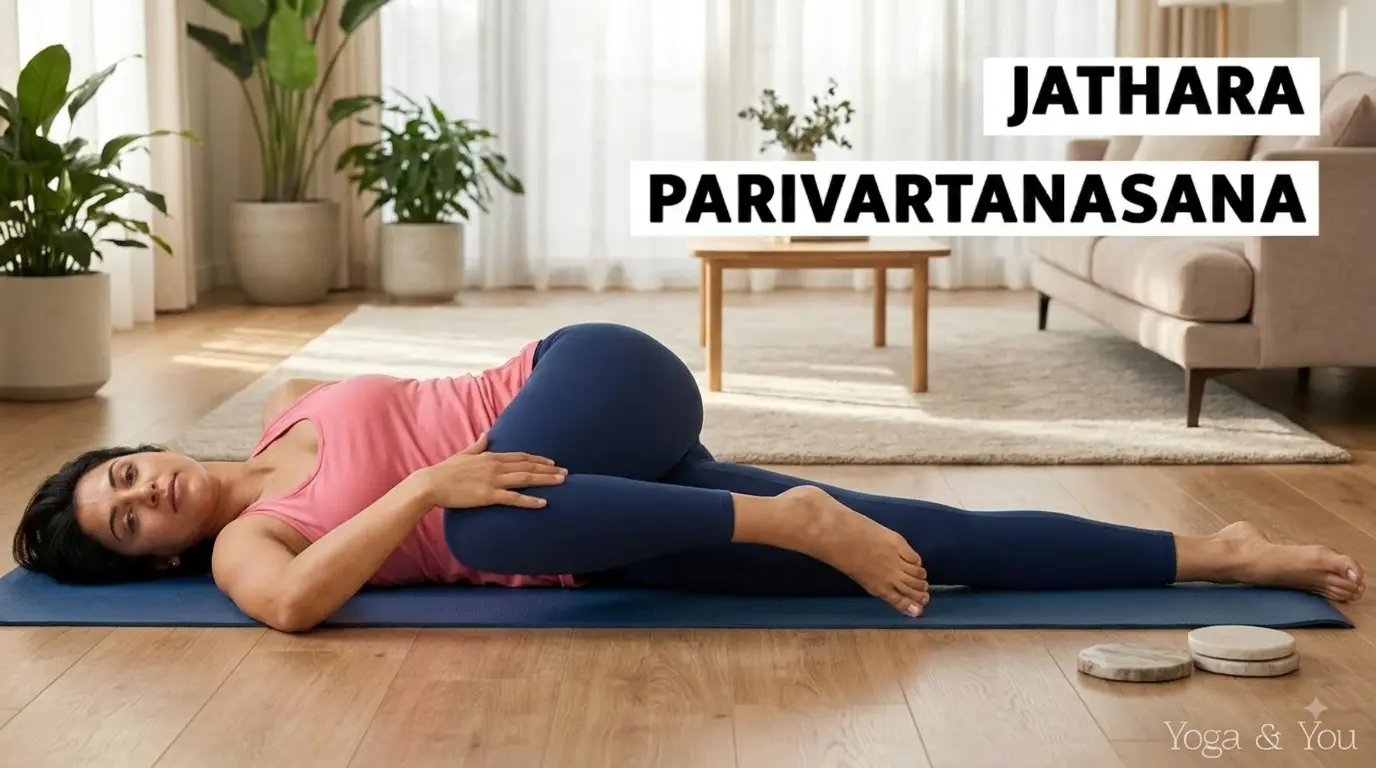
Jathara Parivartanasana: Revolved Abdomen Pose
Jathara Parivartanasana is a form of restorative yoga having many therapeutic benefits for the body. Simple positions are used in certain postures that allow the focus to be put on some parts of the body that are tense due to a long period of sitting, standing, or practicing challenging asanas. Jathara Parivartanasana (Revolved Abdomen Pose) is one of the postures that fit into this category.
Lying down flat on your back, you can incorporate this asana into your practice to rotate the trunk in a controlled way while the shoulders stay stable. It can involve such body parts as the abdomen, hips, lower back, shoulders, and legs, thus being a good option for adding to the end of a yoga practice session. This asana has good therapeutic effects on the body.
Key Takeaways:
-
Lengthens and realigns the spine while releasing tension in the lower back.
-
Stimulates digestion and massages abdominal organs through deep twisting.
-
Relieves stress and calms the nervous system to promote relaxation.
What Is Jathara Parivartanasana (Revolved Abdomen Pose)?
The term Jathara Parivartanasana, a Sanskrit term. “Jathara” denotes the abdomen/belly, “Parivartana” means turning/revolving, and “Asana” is defined as the posture.
In the basic posture, the practitioner lies supine, bends his/her legs, and then starts to move them towards one side. In this case, the torso remains fixed on the floor while the head can be moved to the other side, if it is comfortable for him/her.
Various yoga schools may use their modifications of the posture. Some modifications may imply bent legs, whereas others use straight legs.
Benefits of Jathara Parivartanasana (Revolved Abdomen Pose)
When practised with appropriate technique and within a comfortable range, Jathara Parivartanasana can provide several physical and mindful benefits.
|
|
|
|
|
|
|
|
|
|
|
|
|
|
|
|
|
|
|
|
|
|
|
|
How to Practise Jathara Parivartanasana
Follow the steps while practising the Revolved Abdomen Pose:
Step 1: Lying Down
Start by lying down comfortably in the supine position on the yoga mat. Stretch out both hands horizontally on the sides with hands at shoulder height, forming the letter “T.”
Step 2: Bending the Knees
Both knees should be bent with the aim of bringing them to the torso region. Ensure that the legs are in close contact with each other and also avoid breathing while contracting your abdominals.
Step 3: Rotating the Legs
While exhaling, start rotating the legs slowly towards one side. Do not jerk the legs and ensure that you control them in a gentle manner.
Step 4: Holding the Shoulders Flat
Ensure that you keep both shoulders on the floor. The rotation is done mainly using your lower part of the body and not by lifting the shoulders off the ground.
Step 5: Head Position
Turn the head towards the opposite side where the knees rotate. It is optional to keep the head straight and it is okay to do so.
Step 6: Breathe and Hold
Hold the pose for several breaths, but do not attempt to force your knees towards the floor. Each exhalation should help in relaxation, and not a deeper stretch.
Step 7: Come Back to Center
Slowly bring your knees back to center position and let your spine relax.
Step 8: Reverse the Pose
Reverse the process on the other side to give equal importance to both sides of your body. A gradual return to the neutral position can be done after the pose.
Precautions for Jathara Parivartanasana
Despite being executed in a supine position, this exercise also requires twisting in various parts of the body. Bear in mind the following:
- Start with warming up: Prepare the spine, the hips, and adjacent muscles for deeper twists.
- Prevent any injuries: Consult a professional in case of an existing injury in the back, hips, shoulders, knees, or neck.
- Do not force yourself: Do not drop the legs into position with force.
- Listen to your body: Do not continue twisting until it hurts.
- Utilize props if necessary: A folded blanket or other props will help you perform the pose easily.
- Be careful after operation: Follow any doctor's or instructor's recommendations after the operation on the abdomen or hips.
- Stop if there are warning signs: Pain, numbness, dizziness, or any other unusual sensation requires leaving the pose.
The Bottom Line
Jathara Parivartanasana is one of the floor asanas and involves a gentle twist in the spine and the movement of the hips, abdominal area, shoulder joints, and legs. Due to its supportive nature, the pose is ideal for practicing safe twists within a yoga session, especially at its close.
Instead of trying to achieve a deeper twist, it is important to maintain good shoulder alignment, breathe normally, and move slowly. This simple-looking asana can become a valuable part of your balanced yoga routine with mindful sessions. It’s time to trust the true practice of restoration yoga.
FAQs
1. Is it necessary for me to have my knees touching the floor in Jathara Parivartanasana?
No, since the knees do not have to touch the floor. The right posture is the one that which enables you to retain control and breathe easily while twisting.
2. Is it acceptable for me to move my head when performing this asana?
Yes. You can always turn your head towards the opposite direction if your neck feels alright, but having it upwards is also an appropriate option.
3. Can I perform Jathara Parivartanasana in the bent knee version?
Yes. it is an acceptable option to practice this asana in the bent-knee form first.
4. How long should I remain in this pose?
There is no fixed duration for remaining in this asana. Start with a few breaths on each side.
Disclaimer: The content on LifePositive.com, including articles/blogs on yoga, acupuncture, naturopathy, and other alternative healing modalities for holistic wellness, is for informational and educational purposes only. It is not a substitute for professional medical advice, diagnosis, or treatment. Always consult a qualified healthcare provider before starting any new health protocol or making changes to an existing treatment plan.
Also Read: Astavakrasana
By Umesh Kumar Khiri



Discussion (0)
No comments yet. Be the first to comment!
Leave a Comment
You need to login to post a comment.