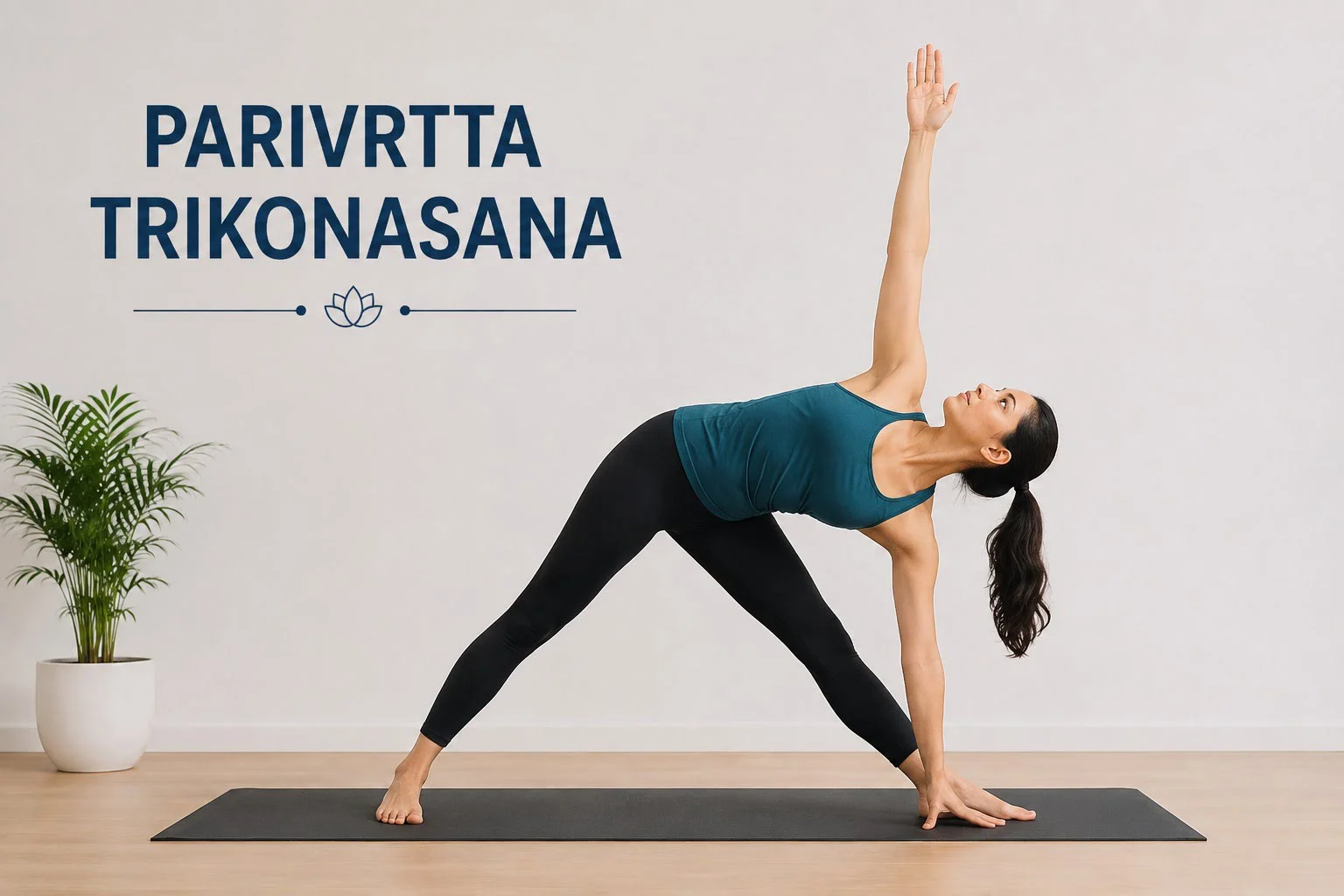
Parivrtta Trikonasana: Revolved Triangle Pose
Parivrtta Trikonasana, or Revolved Triangle Pose, is one example of such a pose, which builds up coordination and balance. It includes stretching as well as gentle twisting while standing upright, working towards improving your posture and building strength in the body.
Through regular practice, Parivrtta Trikonasana can be used effectively as a part of your yoga workout, as it not only helps to enhance flexibility, balance, and coordination but also gives confidence and good posture. By integrating the actions of twisting and folding, Parivrtta Trikonasana helps develop better body awareness along with flexibility of the legs, hips, and spine. The point of twisting here is not how deep you are in the pose but rather steady breathing, balance, and movement.
Key Takeaways:
- Strengthens the legs, ankles, and core while increasing spine flexibility.
- Twisting action massages internal organs to boost digestion and detoxification.
- Improves body balance, opens the chest, and enhances respiratory function.
What Is Parivrtta Trikonasana (Revolved Triangle Pose)?
The name Parivrtta Trikonasana derives from Sanskrit: Parivrtta, which means "revolved" or "twisted," Trikona, which means "triangle," and Asana, which means "pose." The name of the posture hints that it is the twisted version of the standard Triangle Pose.
As it can be seen in Parivrtta Trikonasana, the legs stay on the ground, while the rest of the body gets twisted over the front leg. In other words, the balance and rotation of the spine make the pose a little bit more complicated than the regular Triangle Pose.
To twist one's body in this pose is not necessary to force anything, but, on the contrary, it is better to start with elongating the spine and then make the rotation slowly.
How to Practise Parivrtta Trikonasana (Revolved Triangle Pose)
Take these measures to practice the Parivrtta Trikonasana safely.
- Start with the feet positioned at a distance of about three to four feet from each other.
- Point your right foot forward and turn your left foot in slightly.
- Align your hips square towards the leg in front of you.
- Inhale and elongate your spine.
- Exhale as you bend forward from your hips.
- Place your left hand on the ground, a yoga block, or your shin on the right side.
- Extend your right arm up towards the sky and rotate your chest to the right.
- Engage both your legs and keep breathing steadily.
- Stay in the pose for 15-30 seconds, come out slowly, and switch sides.
Advice for Beginners
- Warm up your hamstring and hip muscles prior to the pose.
- Using a yoga block in case you can't reach the floor.
- Don’t round your spine, but elongate it instead of twisting more deeply.
- Work on your balance before adding any twisting actions.
- Breathe slowly while in the pose.
Wellness Benefits of Parivrtta Trikonasana
Regular practice of Parivrtta Trikonasana (revolved triangle pose) supports flexibility, balance, and overall body awareness.
|
|
|
|
|
|
|
|
|
|
|
|
|
|
|
|
|
|
|
|
|
|
|
|
|
|
|
Tips and Precautions
Practise Parivrtta Trikonasana carefully and within the limits of your flexibility.
- Warm up well before practising the twisting pose.
- Do not lock your knees; keep your legs straight.
- Lengthen the spine first, then rotate the torso.
- Use a yoga block to ensure correct alignment.
- Individuals who have recently suffered an injury to their back, neck, hips, or have balance issues are advised to seek help from a healthcare professional or a yoga teacher.
- Stop immediately if you feel any pain, dizziness or discomfort.
Ending Notes
Parivrtta Trikonasana is a dynamic yoga pose combining several factors into one practice. It is a challenging pose that takes time and effort to get right but will bring many benefits once mastered. Instead of trying to reach the maximum stretch and getting lost in it, focus on controlled breathing and proper alignment.
Frequently Asked Questions
1. Why is the Parivrtta Trikonasana pose more difficult compared to Triangle Pose?
As opposed to the classical Triangle Pose, the Parivrtta Trikonasana involves performing a forward fold and a spine rotation simultaneously.
2. What should I do – look up or down in the pose?
If it is comfortable for your neck, you can look upwards to the raised arm. Otherwise, keep your gaze towards the floor until you feel more balanced.
3. Does the Parivrtta Trikonasana enhance my balance over time?
Yes. It requires coordination and body awareness through the combination of strength and control while maintaining proper alignment.
4. Which yoga poses would be helpful for preparing for Parivrtta Trikonasana?
Some of the foundational standing poses, including Trikonasana (Triangle Pose) and Utthita Parsvakonasana (Extended Side Angle Pose) may prove helpful when preparing for Parivrtta Trikonasana.
Disclaimer: The content on LifePositive.com, including articles/blogs on yoga, acupuncture, naturopathy, and other alternative healing modalities for holistic wellness, is for informational and educational purposes only. It is not a substitute for professional medical advice, diagnosis, or treatment. Always consult a qualified healthcare provider before starting any new health protocol or making changes to an existing treatment plan.
Also Read: Sukhasana
By Umesh Kumar Khiri


Discussion (0)
No comments yet. Be the first to comment!
Leave a Comment
You need to login to post a comment.