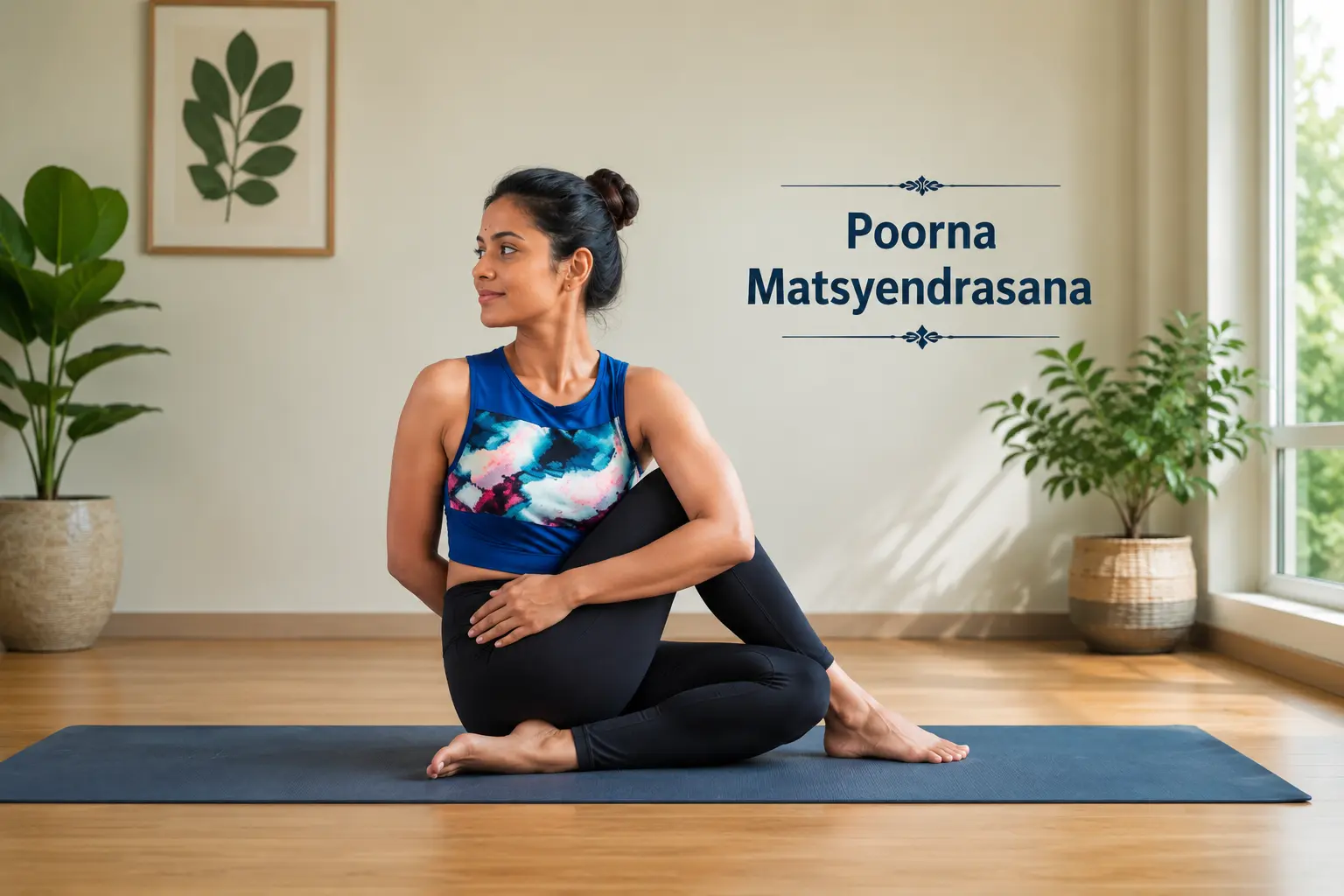
Poorna Matsyendrasana: Full Lord of the Fishes Pose
The pose Poorna Matsyendrasana, which translates to the Full Lord of the Fishes Pose, is one of the finest illustrations of body balance. True mastery in yoga lies in where there is stability and, at the same time, release.
As part of the ancient Hatha Yoga practice, the pose Poorna Matsyendrasana has little to do with flexibility but is instead a great lesson in patience and self-knowledge. It challenges you to move in multiple directions at once, seamlessly weaving a profound spinal rotation with intense, intricate openings of the hips, shoulders, and limbs. To approach it safely is to embrace a journey of mindful progression, honoring the preparatory stages rather than rushing toward the final bind.
Key Takeaways
-
Spinal Detox: Deeply rotates the entire spine to stimulate digestions and organ health.
-
Deep Flexibility: Releases intense tightness across the back, shoulders, and hips.
-
Core Activation: Engages deep core and abdominal muscles to support seated rotation.
What Is Poorna Matsyendrasana (Full Lord of the Fishes Pose)?
“Poorna” in Sanskrit implies completeness or being full; “Matsyendra” is the name of Matsyendranath, and “Asana” stands for posture. So this name symbolizes the completeness of the pose that is associated with Matsyendra’s spinal twist.
In the Poorna Matsyendra Asana pose, one of the legs takes the half lotus pose position, and the other leg bends with the placement of the foot close to the other knee. In turn, the rotation occurs around the bent leg, and the arms take a complex pose in relation to the legs.
Being a combination of a twist and difficult hip and shoulder poses, the asana is considered an advanced yoga pose.
Benefits of Poorna Matsyendrasana (Full Lord of the Fishes Pose)
When performed appropriately, Poorna Matsyendrasana (Full Lord of the Fishes Pose) may contribute to several aspects of physical practice.
|
|
|
|
|
|
|
|
|
|
|
|
|
|
|
|
|
|
|
|
|
|
|
|
|
|
|
|
|
|
|
|
|
|
|
|
How to Practise Poorna Matsyendrasana
Due to its complexity, the full pose should only be attempted once enough mobility and control have been gained.
1. Assume Dandasana Posture
Sit with legs extended in front of the body. The spine must be erect and the sitting bones rooted.
2. Pose the Left Leg
Fold the left leg and bring the left foot into a half-lotus posture close to the right leg. Make sure the knee and hip joints are not strained.
3. Pose the Right Leg
Fold the right leg and place the right foot beside the left knee. Build a firm base for your seat.
4. Lengthen the Spine
Inhale and elongate the spine from the crown of the head. The body must remain erect and not collapse into the lower back.
5. Start the Twist
Slowly twist the torso towards the right. The twisting should come from the torso and not from forcing it using the arms.
6. Bring the Arm In
Move the left arm through the space that exists between the torso and the right leg. The hand of the left arm will depend on how flexible you are and may reach for the outer edge of the right foot.
7. Finish the Arm Position
It is up to the other arm to pass behind the back and bring about the bind that is seen in the full pose.
8. Hold the Pose
Keep the sitting bones anchored to the ground as much as possible and keep breathing normally. Do not twist the torso using the arms.
9. Come out Slowly
Gently unwind the torso and the arms and then change the leg position.
Preparatory Poses
Poorna Matsyendrasana should ideally be approached through progressive preparation rather than as an isolated flexibility challenge.
|
|
|
|
|
|
|
|
|
|
|
|
|
|
|
|
|
|
Precautions for Poorna Matsyendrasana
Prepare yourself well before trying to do the entire pose.
- Never force your hip or knee joints to get into the half-lotus pose.
- Do not practice yoga when in pain, especially sharp pains or joint pains.
- Alter your posture if the full bind is unattainable for you.
- Get help from professionals if you have suffered from any injuries or surgeries recently.
- Stop practicing yoga if you feel dizzy or numb.
- Do not try to do the pose before mastering the mobility and control required for it.
Wrapping Up
The practice of Poorna Matsyendrasana is an intricate pose combining aspects of spinal twist, hip action, shoulder girdle movement, core engagement, and concentration, which make it difficult and dangerous to strive for the final pose only.
However, practicing Poorna Matsyendrasana can become much easier and safer with the gradual development of the needed flexibility in preliminary poses, keeping an upright spine and a stable pelvis, and not forcing the body into uncomfortable positions. When approached mindfully, Poorna Matsyendrasana stops being a mere difficult pose and turns into an effective technique of bodily and mental renewal.
FAQs
1. What is the difference between Ardha Matsyendrasana and Poorna Matsyendrasana?
Ardha Matsyendrasana is the half version and is usually easier to perform. Poorna Matsyendrasana is the full version and involves more complicated leg positioning and arm alignment.
2. Is it obligatory to touch my foot in performing Poorna Matsyendrasana?
No, reaching for your foot is part of the traditional performance; however, you should not force your hand to achieve the desired position.
3. Why does my knee hurt in this position?
The knee pain might be caused by insufficient hip mobility that is necessary to perform the posture in a proper way. You should not force your knee into the position.
4. Is it possible to perform Poorna Matsyendrasana without practising Ardha Matsyendrasana successfully?
It is better to learn to perform simpler twisting poses first since the full version requires much more mobility and coordination skills.
Disclaimer: The content on LifePositive.com, including articles/blogs on yoga, acupuncture, naturopathy, and other alternative healing modalities for holistic wellness, is for informational and educational purposes only. It is not a substitute for professional medical advice, diagnosis, or treatment. Always consult a qualified healthcare provider before starting any new health protocol or making changes to an existing treatment plan.
Also Read: Anjaneyasana
By Umesh Kumar Khiri



Discussion (0)
No comments yet. Be the first to comment!
Leave a Comment
You need to login to post a comment.