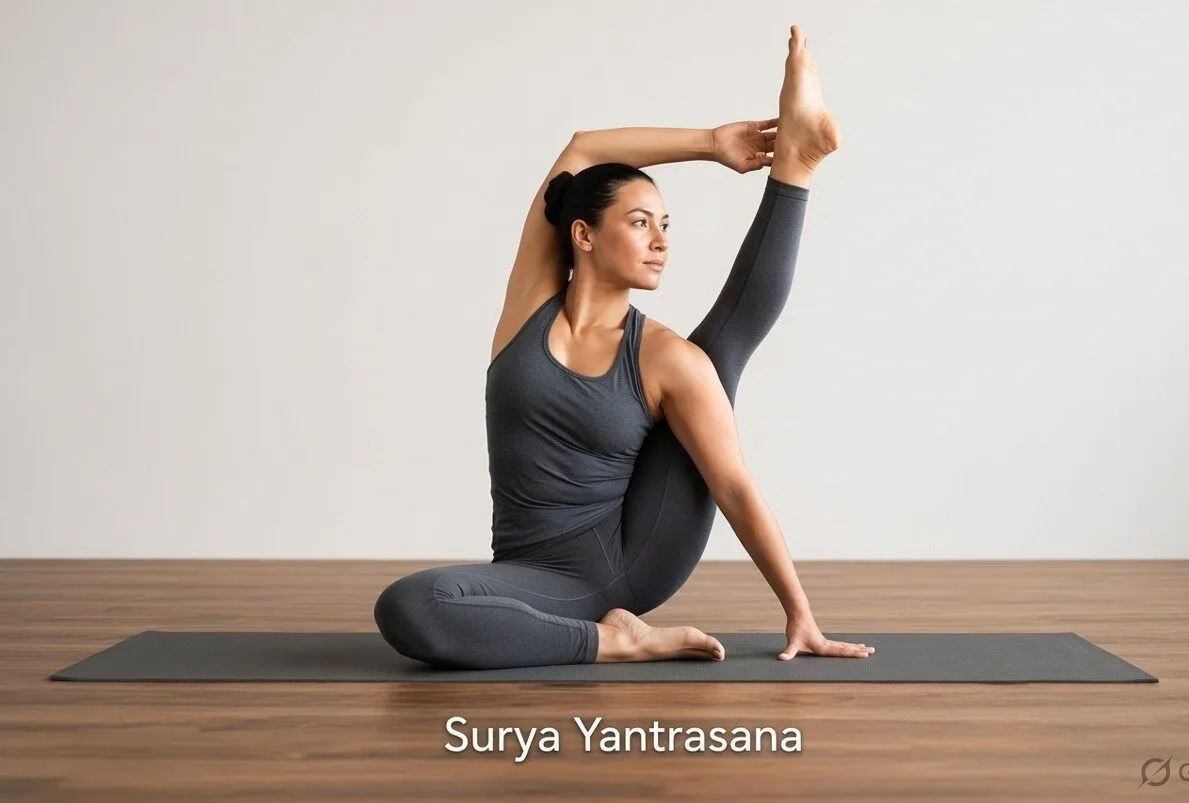
Surya Yantrasana: Health Benefits
Surya Yantrasana, better known as Compass Pose or Sundial Pose, is a challenging seated asana that integrates flexibility, core strength, and rotational movements within the spine. The name of the pose comes from Sanskrit words like “Surya” meaning Sun, “Yantra” meaning Instrument/Dial, and “Asana” meaning Pose. In effect, it is like a compass in our body that not only builds mental toughness but also physical balance.
Key Takeaways
- Advanced Hip and Hamstring Opening: Requires and builds extraordinary flexibility in the adductors, hamstrings, and gluteal complexes.
- Integrated Spinal Rotation: Enhances lateral rib cage expansion and thoracic mobility by combining a side-bend with a deep torso twist.
- Core & Pelvic Stabilization: Demands equal weight distribution across the sit bones to maintain balance while lengthening the leg skyward.
Surya Yantrasana: Alignment & Modern Practice
Warm-ups are required for Surya Yantrasana, such as lizard lunges or bound angle poses, to ensure the shoulder joint and legs are prepared for deep stretching. Alignment is needed for the lifted leg to be able to rest over the upper arm without reducing the spine’s length.
Variations of Surya Yantrasana (Compass Pose)
Some of the common variations of the asana Surya Yantrasana are as follows:
|
|
|
|
|
|
|
|
|
|
|
|
|
|
|
|
|
|
|
|
|
|
|
|
|
How to Perform Surya Yantrasana (Compass Pose)
Follow these steps to practice Surya Yantrasana:
- Begin in Baddha Konasana: Sit straight with the heels of your feet pressed together.
- Hug the Leg: Pull your right leg towards yourself and slip your right hand under the bend in your right knee.
- Place the Shoulder: Raise your right knee up and put it across your right shoulder, keeping your right fingers grounded on the floor in line with your hip.
- Hold the Foot: Stretch your left hand overhead to grab your foot's outer edge.
- Lift and Lie Back: As you exhale, extend your right leg upwards in a diagonal direction away from your body.
- Turn the Body and Look Up: Lean back to open your chest and turn your body leftwards with your gaze up in front of your left armpit.
Health Conditions Managed
Regular sessions of Surya Yantrasana help manage the following conditions:
- Digestive Issues and Bloating: The yoga pose increases blood flow to the internal abdominal organs for good digestive health.
- Tight Hip Flexors and Strained Hamstrings: Regular practice of Surya Yantrasana releases tension that is held within the lower body.
- Stagnant Pelvis: The yoga asana opens up the groin area and increases blood flow to the reproductive and pelvic areas.
- Mental Exhaustion and Stress: This yoga pose needs concentration and deep breathing, calming the nervous system and creating mental stability.
Key Precautions
Follow these measures while performing Surya Yantrasana (Compass Pose):
- Prevent Collapse of Lumbar Spine: Make sure that your lumbar spine remains straight and avoid the collapse of the lumbar vertebrae.
- Take Care of Your Hamstrings: You need to warm up properly to avoid any sharp pain in the hamstrings or adductors while extending the leg.
- Shoulder Considerations: If your shoulders are tight, you should not force the leg above the arm.
- Avoid During Active Injuries: Stay away from this pose if there is an injury to your wrist, groin, sciatica, or herniated discs in your spine.
To Conclude
Surya Yantrasana offers an empowering journey into deep hip mobility, shoulder opening, and spinal fluidity. By honoring your body’s natural boundaries, using proper modifications, and maintaining steady diaphragmatic breathing, you can safely explore this advanced posture.
Regular practice of the Compass Pose not only builds functional flexibility and core stability but also fosters grounded mental resilience both on and off the mat.
Frequently Asked Questions
1. Which body areas are stretched in Surya Yantrasana?
In Surya Yantrasana, the hamstrings, hip adductors, and shoulder girdle are the main areas being stretched out.
2. Can beginners practice Surya Yantrasana?
No, Surya Yantrasana is an advanced pose requiring a lot of hamstring flexibility and flexibility in the hip area. Beginners can start with the preparatory poses like Lizard Lunge and Janu Sirsasana.
3. What are the 12 names of asanas in Surya Namaskar?
The 12 asanas in Surya Namaskar are: Pranamasana, Hasta Uttanasana, Hasta Padasana, Ashwa Sanchalanasana, Dandasana, Ashtanga Namaskara, Bhujangasana, Adho Mukha Svanasana, Ashwa Sanchalanasana, Hasta Padasana, Hasta Uttanasana and Pranamasana.
4. Which asana in Ashtanga yoga is the hardest?
It depends on the practitioner, but Karandavasana (Duck Pose) from the Intermediate Series and some arm balances from the Advanced A Series can be considered to be the hardest asanas.
Disclaimer: The content on LifePositive.com, including articles/blogs on yoga, acupuncture, naturopathy, and other alternative healing modalities for holistic wellness, is for informational and educational purposes only. It is not a substitute for professional medical advice, diagnosis, or treatment. Always consult a qualified healthcare provider before starting any new health protocol or making changes to an existing treatment plan.
Also Read: Baddha Konasana
By Umesh Kumar Khiri
.png)


Discussion (0)
No comments yet. Be the first to comment!
Leave a Comment
You need to login to post a comment.