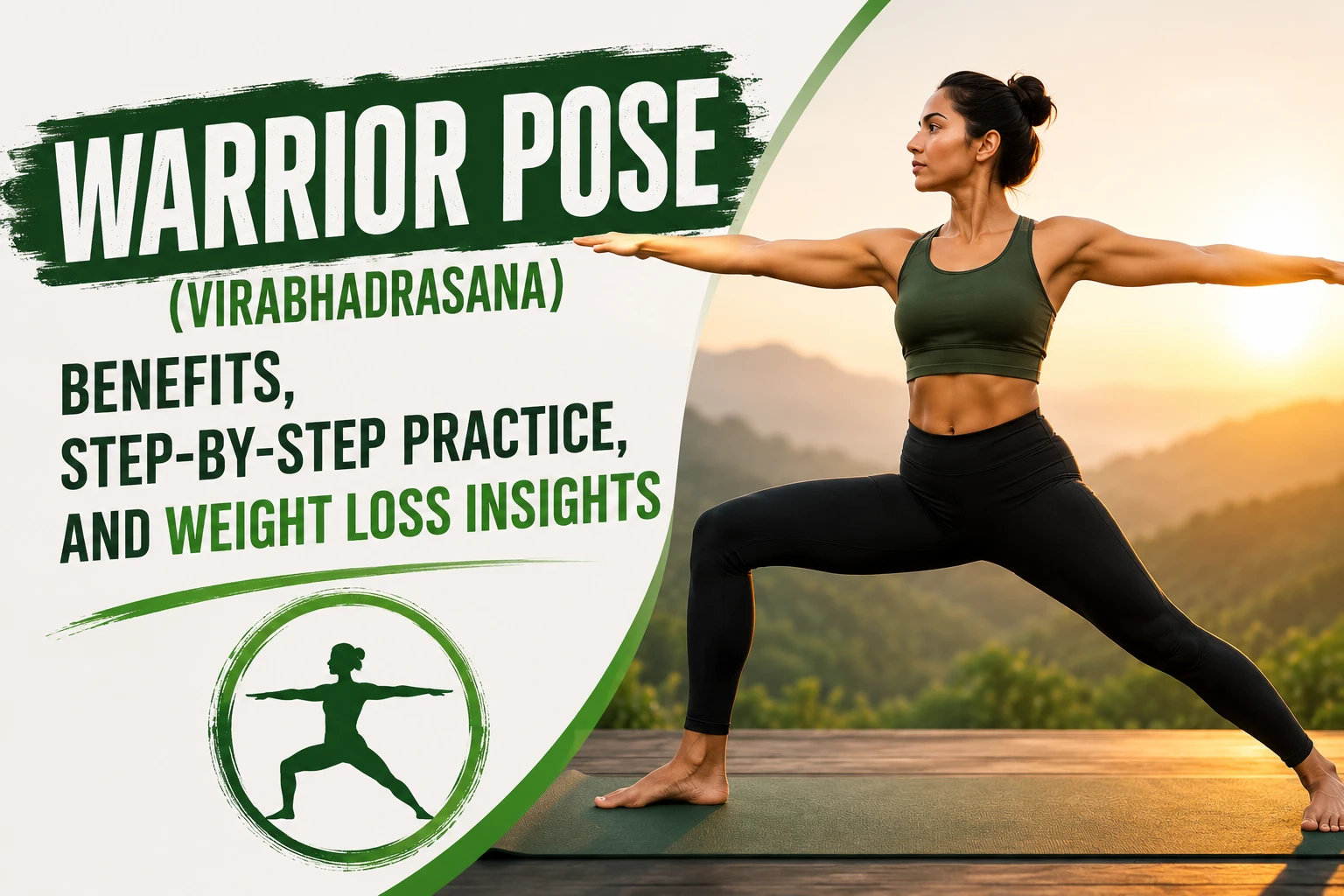
Warrior Pose (Virabhadrasana): Benefits, Step-by-Step Practice, and Weight Loss Insights
Warrior Pose (Virabhadrasana) is a prominent standing yoga posture designed to strengthen the legs, open the hips, and cultivate full-body stability and stamina. Named after Virabhadra, a powerful warrior from Hindu mythology, this dynamic posture combines lower-body resistance work with physical focus.
Practicing Warrior Pose regularly is essential for developing functional balance, improving operational posture, and building lower-body muscle tone. Beyond flexibility and strength, it serves as an accessible high-engagement posture for those aiming to increase daily calorie expenditure and enhance metabolic health.
What Is Virabhadrasana? History and Meaning
In Sanskrit, Vira translates to "hero" or "warrior," Bhadra means "friend" or "auspicious," and Asana refers to a "posture" or "seat." Together, Virabhadrasana signifies a powerful pose that embodies courage, focus, and strength.
Unlike many relaxing restorative postures, Warrior Pose demands full-body engagement. It activates major muscle groups simultaneously—including the quadriceps, hamstrings, gluteus maximus, shoulder girdle, and deep core stabilizers—making it a staple sequence across Vinyasa, Hatha, and Ashtanga yoga styles.
Key Benefits of Warrior Pose (Virabhadrasana)
Practicing Warrior Pose consistently yields distinct physical, mental, and physiological advantages:
Builds Lower-Body Muscle Strength: Holding the lunged position strengthens the quadriceps, hamstrings, calves, and ankles.
Enhances Core Stability and Balance: Stabilizing the torso over a wide base engages the abdominal wall and spinal erectors.
Opens Hips and Chest: Deep lunging opens tight hip flexors and groin muscles, while arm extensions open the chest cavity for improved respiratory volume.
Promotes Joint Integrity: Weight-bearing engagement through the knees, hips, and ankles strengthens surrounding ligaments and improves joint alignment.
Aids in Caloric Expenditure: Holding large-muscle isometric postures increases heart rate and overall energy expenditure, assisting in weight management protocols.
Overview of the 3 Main Warrior Pose Variations
Virabhadrasana consists of three primary variations, each offering distinct mechanics, muscular activation patterns, and levels of difficulty.
| Variation | Primary Focus | Main Muscles Targeted | Skill Level |
| Warrior I (Virabhadrasana I) | Hip opening & spinal extension | Quadriceps, hip flexors, shoulders, chest | Beginner to Intermediate |
| Warrior II (Virabhadrasana II) | Hip abduction & lateral stability | Adductors, glutes, deltoids, core | Beginner |
| Warrior III (Virabhadrasana III) | Single-leg balance & posterior chain strength | Hamstrings, glutes, erector spinae, deep core | Intermediate to Advanced |
How to Perform Warrior Pose (Virabhadrasana) Step-by-Step
Proper alignment prevents joint strain—particularly in the knee and lower back—while maximizing muscle activation.
How to Practice Warrior I
- Starting Position: Stand at the front of your mat in Tadasana (Mountain Pose). Step your left foot back roughly 3 to 4 feet.
- Foot Alignment: Turn your left back foot outward at a 45-degree angle, grounding firmly through the outer heel. Keep your right front foot pointed directly forward.
- Square the Hips: Rotate your hips forward so both hip bones point toward the front edge of the mat.
- Bend the Front Knee: Exhale and bend your right knee until it sits directly over your ankle, forming a 90-degree angle (ensure the knee does not cave inward or extend past the toes).
- Arm Elevation: Inhale and raise both arms overhead, palms facing each other or touching, keeping shoulders drawn down away from the ears.
- Hold: Maintain the pose for 30 to 60 seconds while taking smooth, deep breaths. Switch sides.
How to Practice Warrior II
- Setup: From Tadasana, step your left foot back about 3.5 to 4 feet.
- Foot Placement: Turn the left foot out 90 degrees so the back heel aligns with the arch of your front right foot.
- Open the Hips: Keep your hips and torso open toward the side edge of the mat rather than squarring them forward.
- Arm Extension: Extend your arms parallel to the floor at shoulder height—right arm forward, left arm backward—actively reaching through the fingertips.
- Lunge: Bend the front right knee to 90 degrees. Turn your gaze over the middle finger of your front hand.
- Hold: Maintain active leg drive and core tension for 30 to 60 seconds before switching sides.
Can Warrior Pose Help with Weight Loss?
A common question among practitioners is whether holding static postures like Virabhadrasana can assist with body weight management.
The Physiology of Isometric Muscle Engagement
Warrior Pose relies heavily on isometric muscle contraction—where muscles generate force without changing length. Holding a deep lunge forces the body's largest muscle groups (glutes and quadriceps) to maintain high tension. This process:
- Increases Energy Demand: Large muscle recruitment demands oxygen and glucose, elevating calorie burn above baseline resting levels.
- Supports Lean Muscle Mass: Building leg strength increases resting metabolic rate over time.
- Enhances Circulation: Dynamic transitions between Warrior variations (such as in Vinyasa flows) elevate heart rate, promoting cardiovascular efficiency.
While practicing Warrior Pose alone will not substitute for an overall energy deficit diet, integrating high-intensity yoga flows that feature Virabhadrasana into a weekly routine effectively supports weight loss goals, fat reduction, and body re-composition.
Common Alignment Errors and How to Avoid Them
- Front Knee Collapsing Inward: Ensure the front knee tracks directly over the second toe to prevent lateral stress on the knee ligament (MCL).
- Overarching the Lower Back: Keep the pelvic floor neutral and draw the lower ribs gently inward to avoid lumbar compression, especially in Warrior I.
- Lifting the Back Heel: Keep the outer edge of the rear foot firmly pressed into the mat to maintain structural integrity and stretch the calf/Achilles tendon.
- Shoulders Hunching: Relax the upper trapezius muscles by dropping shoulders away from the ears while extending through the arms.
Frequently Asked Questions (FAQs)
What are the main benefits of Virabhadrasana?
Virabhadrasana strengthens the leg muscles, hips, and core while improving joint stability, posture, balance, and stamina.
Can beginners practice Warrior Pose safely?
Yes, beginners can safely practice Warrior I and II by reducing the depth of the lunge or adjusting the stance distance to fit their current mobility level.
How long should I hold Warrior Pose during a practice?
Holding each variation for 30 to 60 seconds (roughly 5 to 8 deep breaths) per side provides optimal strength and endurance benefits.
Is Warrior Pose effective for burning fat?
While not a pure cardiovascular exercise, holding Warrior Pose builds lean muscle tone and raises energy expenditure, making it a valuable addition to a weight management program.
Who should avoid or modify Virabhadrasana?
Individuals with high blood pressure, recent shoulder injuries, severe knee damage, or spinal issues should modify the depth of the pose or perform it under qualified guidance.
Conclusion
Warrior Pose (Virabhadrasana) remains one of the most effective yoga postures for building foundational strength, improving posture, and enhancing metabolic endurance. By mastering foot alignment, maintaining proper joint tracking, and holding the posture mindfully, you can safely unlock both its mental and physical rewards. Incorporate Warrior variations into your daily movement routine to build lasting lower-body power and balance.



Discussion (0)
No comments yet. Be the first to comment!
Leave a Comment
You need to login to post a comment.