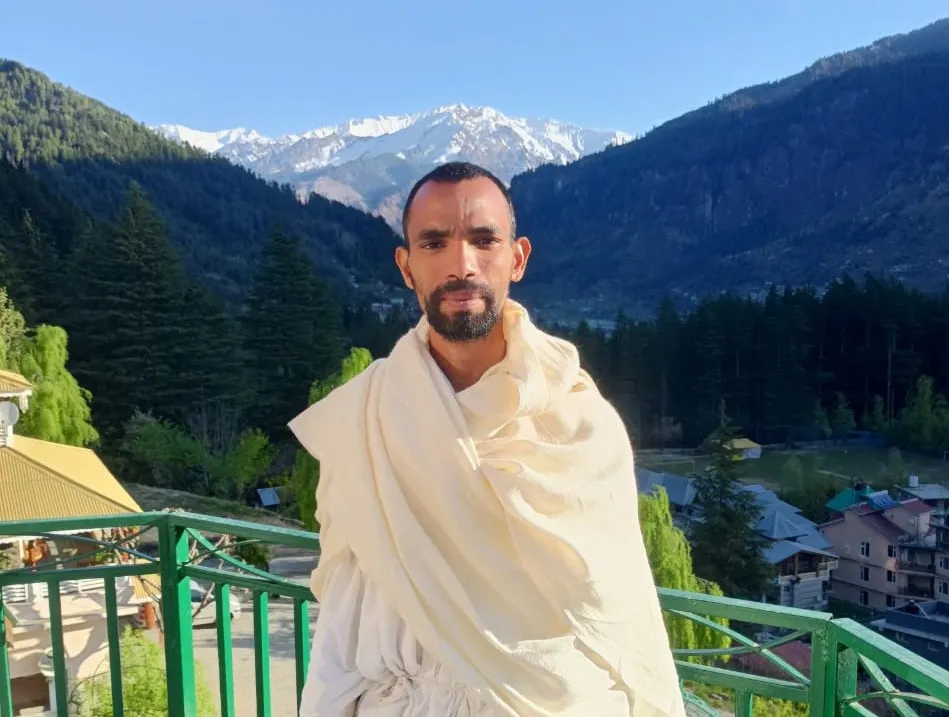
When the Search Within Becomes a Way of Life
By Vandana Khaitan
The remarkable journey of Yogi Brahma Vidya Chaitanyaji—from a promising young life to the path of meditation, self-inquiry and Self-realization
What if the most important journey of your life was not towards a destination, a career, or a material achievement, but towards discovering who you truly are?
For Yogi Brahma Vidya Chaitanyaji, this question became the foundation of his life.
At the age of 25, while pursuing the kind of life many young people would consider desirable, he made an unusual choice. He stepped away from worldly pursuits and turned towards spirituality. His decision was not born from failure, heartbreak, or disappointment. It came from an inner longing for God.
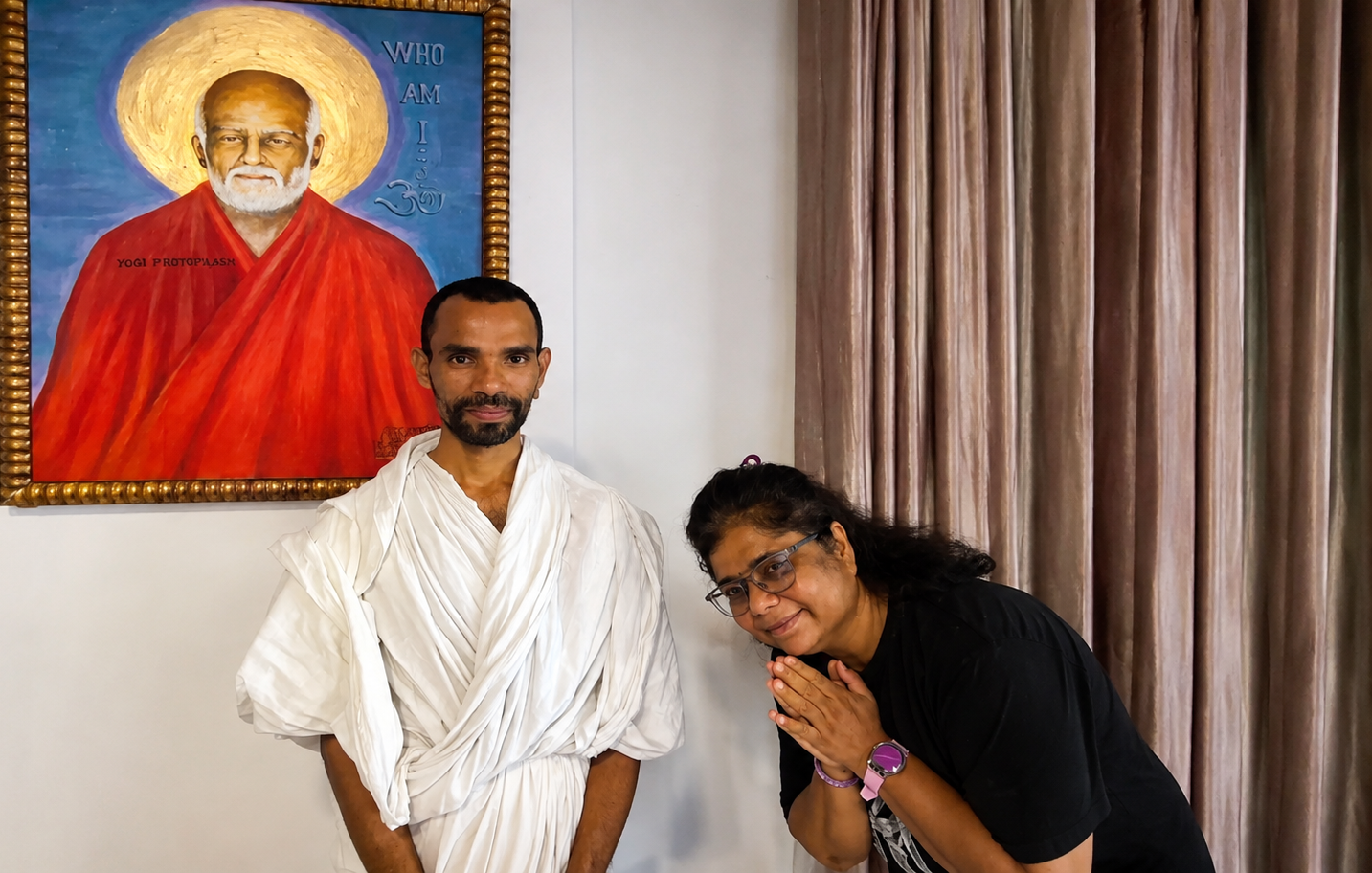
Today, he conducts intensive meditation retreats at Vedanagari Ashramam in Tiruvannamalai, Tamil Nadu, and elsewhere in India. A disciple of the late Yogi Protoplasm, also known as Swami Prajnaranyaji, and influenced by the teachings of Ramana Maharshi, his approach to spirituality is centred on meditation, silence, self-inquiry and direct experience.
For him, spirituality is not primarily about acquiring more knowledge. It is about transforming knowledge into experience.
A different kind of renunciation
Renunciation is often associated with people who have experienced deep suffering or who have become disillusioned with worldly life. Chaitanyaji's story does not follow that familiar pattern.
He had the opportunities of a conventional young life, including an engineering education and family comforts. Yet an inner call drew him towards another direction.
He explains his decision through the idea of spiritual opportunity. Human birth itself, he believes, is precious. A genuine desire for Self-realization is rarer still, and finding a true Guru who can guide a seeker towards Truth is rarer again.
His understanding is also influenced by the Bhagavad Gita's teaching that sincere spiritual effort is never wasted. Spiritual practice, he believes, continues beyond the limitations of one lifetime.
His grandfather's life as a yogi also became significant in his understanding of his own path.
Thus, what might appear to an outsider as a dramatic sacrifice was, for Chaitanyaji, simply the next step in a spiritual journey.
When a Guru becomes a living teaching
The meeting with Yogi Protoplasm changed Chaitanyaji's understanding of spirituality.
What stayed with him most was not merely his Guru's words but the way he lived. Chaitanyaji recalls experiencing his Guru's deep care for his disciples, both physically and spiritually.
There were moments when his Guru seemed to understand situations without conventional explanations. Chaitanyaji remembers occasions when his Guru guided him about whether to go somewhere or remain at the ashram, and later events appeared to confirm that guidance.
Such experiences strengthened his conviction that spiritual realization is not simply a matter of intellectual understanding.
Another memory particularly influenced him. When someone asked his Guru to move towards the centre of a bed, the Guru responded by questioning the very idea of being limited to one physical location.
For Chaitanyaji, such experiences reflected the essence of Advaita—the recognition that consciousness is not ultimately confined to the body.
His Guru therefore became, in his eyes, more than a teacher of philosophy. His very way of being became a teaching.
The difference between knowing and living
We live in an age when spiritual knowledge is readily available.
Books, scriptures, lectures, online videos, and courses can introduce us to almost every spiritual tradition. Yet Chaitanyaji raises an important question: does knowing about spirituality necessarily make us spiritual?
His answer is no.
A person can read the Bhagavad Gita repeatedly without allowing its teachings to transform everyday life. One can discuss meditation without actually sitting in silence. One can talk about awareness while remaining completely identified with one's thoughts.
For Chaitanyaji, practice is therefore essential.
His Guru's retreats were designed around this principle. Participants engaged in long periods of meditation, silence and disciplined spiritual practice, including stages of Om chanting.
The emphasis was not on accumulating information. It was on experiencing what the teachings pointed towards.
This remains the foundation of Chaitanyaji's own retreats.
Meditation is an experience, not a discussion
Chaitanyaji believes that modern seekers often remain at the level of listening and reflection.
In traditional spiritual language, listening to teachings is shravana. Reflecting upon them is manana, while deeply assimilating them through contemplation and meditation is nididhyasana.
He places particular emphasis on the third.
The Bhagavad Gita contains 700 verses, but simply memorising those verses, he suggests, is not enough. Even one teaching can become transformative if it is genuinely practised.
His own experience illustrates this philosophy.
During his early spiritual training, he gradually developed the ability to sit in meditation for increasingly long periods. What began with three-hour sessions eventually extended to six, nine, and even twelve hours.
He attributes this progress to the grace and guidance of his Guru.
Today, the retreats he conducts similarly emphasise extended meditation and silence, with the larger purpose of turning the seeker inward.
What happens when we stop fighting our minds?
For many people, meditation becomes difficult because the mind refuses to become quiet.
The moment we sit down, thoughts appear. Memories, plans, worries and desires compete for attention.
Our instinct often fights them.
Chaitanyaji suggests another approach: observe.
Instead of asking, "How do I get rid of my thoughts?", he encourages the seeker to investigate the nature of the mind itself.
What is the mind?
According to the perspective he teaches, the mind can be understood as a collection or movement of thoughts. If thoughts are constantly changing, can they really be the deepest Self?
The practice, therefore, is to become a witness.
Watch the thought without immediately becoming the thought.
Observe the emotion without immediately identifying with it.
Notice the desire without automatically following it.
With continued practice, thoughts may gradually lose their power to control attention.
This shift from identification to observation is central to the inward journey.
Simplicity as spiritual discipline
Chaitanyaji's personal lifestyle is also closely connected with his spiritual practice.
Like his Guru, he has followed a milk-based diet for many years. During his time at the ashram, food was simple and sattvic, including fruits and sprouts.
He recalls that when his Guru suggested trying a diet consisting only of milk, he accepted the instruction immediately.
For Chaitanyaji, this was primarily an act of obedience to his Guru rather than an attempt to promote a particular diet as a universal prescription.
He believes that a sattvic lifestyle can support meditation by creating greater physical and mental steadiness.
The larger principle behind this simplicity is restraint.
When our lives are dominated by endless wants, the mind remains constantly occupied. Reducing unnecessary stimulation can create more space for introspection.
In this sense, simplicity becomes not an end in itself but a support for spiritual practice.
Are we the body, the mind—or something deeper?
One of the central questions in Chaitanyaji's teaching is the distinction between the body, the mind and the Self.
The body is constantly changing. Childhood becomes youth, youth becomes old age, and physical conditions change from moment to moment.
The mind is equally changeable. Thoughts appear and disappear. Moods shift. Beliefs evolve. Desires arise and fade.
Yet something seems to remain aware of all these changes.
What is that?
Chaitanyaji points towards the Advaitic understanding of the Self as Sat-Chit-Ananda—existence, consciousness and bliss.
From this perspective, Self-realization is not about becoming something new. It is about recognising the deeper reality that has always been present.
Two questions that can change the direction of attention
Chaitanyaji encourages seekers to contemplate two fundamental questions:
What am I?
Where am I?
First, these questions may sound abstract. But their purpose is to turn attention away from external identities and towards the experiencer.
We normally introduce ourselves through our name, profession, family, achievements, and possessions.
But none of these remains unchanged.
Even the body we identify as "me" changes continuously.
So, who is the one who knows all these changes?
This is where self-inquiry becomes more than philosophy.
Instead of accepting an answer simply because a scripture or teacher has provided it, the seeker is encouraged to investigate directly.
The aim is not to create another belief but to discover one's own experience.
Beyond the search for temporary benefits
Many people begin meditation because they want peace of mind.
Some seek relief from stress. Others want greater concentration, emotional balance or physical and mental well-being.
Chaitanyaji acknowledges these benefits, but he places them in perspective.
For him, these are secondary outcomes.
The ultimate purpose of the spiritual path is Self-realization—the recognition of the relationship between Atman and Paramatman.
This changes the question from "How can meditation make my life better?" to something much deeper:
Who is the "I" whose life I am trying to improve?
That question takes the seeker from the surface of experience towards its source.
The art of remaining peaceful
Spirituality, according to Chaitanyaji, is also tested in ordinary life.
It is relatively easy to speak about peace while everything is going according to our wishes. The real challenge comes when circumstances change.
Something we desire may be taken away.
Something we dislike may appear.
We may experience praise one day and criticism the next.
The spiritual practitioner gradually learns to observe these opposites without becoming completely controlled by them.
This does not mean ignoring life's practical realities. It means developing an inner steadiness that does not depend entirely on favourable circumstances.
Such equanimity is an important theme in the Bhagavad Gita and forms an essential part of the yogic ideal.
From spiritual information to inner transformation
The most striking aspect of Yogi Brahma Vidya Chaitanyaji's journey is perhaps its simplicity.
His message does not ask seekers to accumulate endless spiritual concepts.
Instead, it brings them back to practice.
Sit.
Be silent.
Observe the mind.
Question about your identity.
Look beyond the changing body and thoughts.
And discover what remains.
In a world where spirituality can easily become another form of information consumption, his teaching offers a reminder that the deepest truths cannot be fully understood merely by reading about them.
They have to be lived.
Chaitanyaji's own life reflects this conviction. At 25, he turned away from a conventional path and devoted himself to the search for God. Guided by his Guru, he immersed himself in meditation, silence, and self-inquiry. Today, he continues to invite others into that inward exploration through his retreats.
Perhaps the most important lesson from his journey is not that everyone must renounce the world.
It is that every seeker can begin to examine the person they spend their entire life assuming themselves to be.
Who am I beneath my name?
Who am I beneath my roles?
Who am I beneath my thoughts?
And when everything temporarily falls away, what remains?
For Yogi Brahma Vidya Chaitanyaji, this inquiry is not the end of spirituality.
It is where the real journey begins.
This article is based on an interview with Yogi Brahma Vidya Chaitanyaji conducted by Vandana Khaitan. The original interview also discusses his meditation retreats at Vedanagari Ashramam and his teachings rooted in Advaita Vedanta, self-inquiry, and meditation.
About author
Vandana Khaitan, born into a well-known business family in New Delhi, underwent a transformative spiritual journey after a turbulent adolescence and adulthood. She credits her mentor, Yogi Protoplasm, a direct disciple of Ramana Maharshi, with guiding her through personal challenges and towards spiritual awakening. www.vandekrsnafoundation.org


Discussion (0)
No comments yet. Be the first to comment!
Leave a Comment
You need to login to post a comment.