
Demystifying the God Particle
August 2012
Almost half a century after its existence was predicted, the combined findings of two teams ATLAS and CMS, in the world's largest and highest-energy particle accelerator, the $110 billion Large Hadron Collider (LHC) – a 27 km-long tunnel under the Franco-Swiss border near Geneva at European Centre for Nuclear Research (CERN), the work of 6000 physicists finally came to an end.
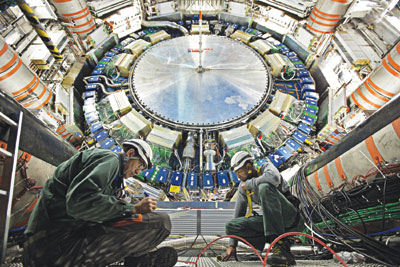
Scientists at work inside the LHC The Higgs Boson particle, or the God particle, seems to have been discovered.
So what exactly is Higgs Boson? Its name is a combination of British physicist Peter Higgs and the Indian scientist, S.N. Bose.
What has God got to do with it? In 1993, the Nobel Prize winner Leon Lederman unwittingly dropped the term in his popular, non-fiction, science book, The God Particle: If the Universe Is the Answer, What Is the Question? (They say he wanted to refer to the Higgs Boson as the 'goddamn particle' but his editor didn't allow that) According to D. Karl Kruszelnicki University of Sydney, Higgs Boson matters, because “you are made of particles that have no size, and no mass (separated by a vacuum). But somehow, there you are.” So the challenge is to know, how does one, who is full of particles with no size or mass, accumulate weight?
The answer lies in the Higgs field. Higgs Boson is the particle in the Higgs field. It was first posited in 1964 by six physicists, including Briton Peter Higgs to explain why some particles, such as quarks, building blocks of protons, and electrons have mass while others, such as the light-carrying photons, do not. According to the standard model of Physics, the universe is made of 12 fundamental particles and four fundamental forces. The four basic forces of nature are – strong, weak, electromagnetic and gravity. While 11 particles predicted by the model had been found, the last missing piece – the Higgs Boson, hadn’t.
The Higgs theory explores the weak interactions which are responsible for nuclear beta decay and are crucial for converting protons into neutrons. (This fusion reaction in which protons turn into neutrons is the reason the sun shines.) For 30 years, physicists have known that the weak interactions can only be explained if the universe is filled with a mysterious energy field (called the Higgs field). If a particle can move through this field with little or no interaction, there will be no drag, and that particle will have little or no mass. Alternatively, if a particle interacts significantly with the Higgs field, it will have a higher mass.
When the weak force carriers along with quarks and leptons (basic building blocks of matter) react with the Higgs energy field, then mass (or matter) is produced. Therefore the Higgs field or its corresponding Higgs particle does the work of God – i.e. create matter which has become our present universe. No mass, no matter. No matter, no life. Its discovery opens a new chapter in our understanding of the Universe. The British newspaper, The Independent, called it “One of the greatest achievements in science, rivalling the discovery of the structure of DNA in 1953 and the Apollo moon landings of the 1960s and 1970s.”
“Whatever form the Higgs particle takes,” stated the CERN press release, “our knowledge of the fundamental structure of matter is about to take a major step forward.”
And yet in the larger scheme of things much more needs to be discovered. After all, there’s much more to God than a mere particle!
- Aparna Sharma


Discussion (0)
No comments yet. Be the first to comment!
Leave a Comment
You need to login to post a comment.