
Gandhi goes to school
October 2011
Shishuvan, an ICSE school in the heart of Mumbai city, is borrowing a few leaves from the Mahatma’s book in order to forge an Indian identity.
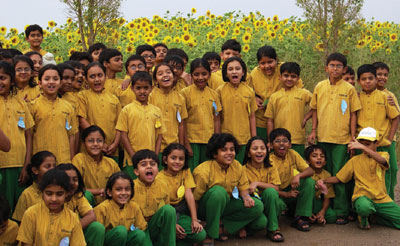
Shishuvan kids, wearing their khadi with pride For starters, the school adopted a khadi uniform, probably the only school in India to do so, right from its inception 12 years ago.
The choice was a challenging one. “We had to make sure that it was easy to maintain, the colours did not fade too much, or the fabric didn't look too crushed,” says Kavita Anand, the executive director of the school.
They approached Udyog Bharati, one of the largest co-operatives in Kutch, for a fabric with 85 per cent cotton, instead of the poly-khadi available in the market then, with as much as 66 per cent polyester. The co-operative based in Gondal, Saurashtra, was started by a Gandhian, to empower the village women, and the looms are operated only by them.
The school has also linked their 10-day annual field trip for fifth graders with a trip to Kutch. “Their last stop is Gondal, where they actually see how the uniforms are made. They witness how the women working in the co-operative now have a livelihood, with which they can afford pucca houses, and goats and can save,” says Kavita.
The uniforms are unisex – a kurti and a pant, with a Nehru collar and wooden front buttons. “We decided to do away with shorts and skirts, to protect the children from falls and mosquito bites, whilst on field trips.
As for the bright yellow and green colour of the uniform, it represents the sunflower which is also the school logo,” says Kavita.
As part of the Socially Useful Productive Work (SUPW), an important part of the ICSE curriculum, the school decided to adopt takli (the process of hand-making the thread from a ball of cotton, which then goes into the charkha, to make it a stronger thread). Touched by the school’s initiative, the takli lessons are taught by none other than the noted Gandhian, Ushaben, who took on the challenge, “because so few are learning to weave on the charkha now.”



Discussion (0)
No comments yet. Be the first to comment!
Leave a Comment
You need to login to post a comment.