
Invitations to the flowering
May 2011
Becoming Buddha - Wisdom Culture for a meaningful Life, Edited By: Renuka Singh, Published By: Penguin Ananda, Pages: 184, Rs 399
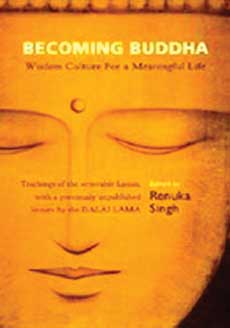 It is amazing how richly leavened with insights lectures by Buddhist monks tend to be. This book, a collection of talks given by several monks, including the Dalai Lama, at the Tushita Mahayana Meditation Centre, New Delhi, is no exception. The talks date from 1979 onwards, when the centre opened shop. It also has a section titled The Politics of Enlightenment by Professor Robert Thurman. Among its other delights is the Dalai Lama’s frank admission that the orthodox Buddhist position on some matters could do with revision. While Buddhism has important insights to offer on the subject of psychology and even cosmology, he admits, writers like Vasubandhu, a great master, had it wrong when he maintained that the earth was flat with Mount Meru at the centre. “I often tell the Buddhist community that if the author returns to this earth, he will have to rewrite that chapter. As followers of the Nalanda tradition, we should reject these concepts because they are contradictory to modern, scientific findings. We must accept the reality and not just mental projections....I really admire genuine scientists who are unbiased and objective. Religious people sometimes become rigid. ” In the talk that opens the book, the Dalai Lama dwells at length on the theme. He reminds his listeners of the Buddha’s words: “Test my words carefully as goldsmiths assay gold and only then accept them.” The second talk by Kyabje Ling Rinpoche speaks on the subject of developing bodhichitta, which is the aspiration or attitude to work for one’s enlightenment so one may benefit the entire world. It is, according to the Lama, a flowering of spiritual practice, of compassion and love for all sentient beings. “It does not matter what we look like, how we dress, how healthy or powerful we are, whether or not we have clairvoyance or miraculous powers, or how learned we are. As soon we generate bodhichitta, we become bodhisattvas,” Rinpoche says. The three themes: developing compassion for all sentient beings, analysing all teachings in the light of reason and the need for steady practice are elaborated upon by the speakers through the book. The Dalai Lama says one needs to also understand that not all of the Buddha’s teachings are for everyone. Some, he says, were spoken in specific situations to people of specific dispositions. The only test in such cases, says Dalai Lama, is to ask oneself if they hold up to reality. All said, the talks, though illuminating, mostly cover old ground. It is Thurman’s chapter towards the end that makes the book special for its beautiful insights into the Buddha’s role in shaping India and world thought, society and even politics by setting the wheel of his dharma in motion. The Buddha's insight into anatma or non-self, he posits, attacks all tribal notions of superiority. 'This is so as the lack of a fixed self as referrent of the various conventional identities (i.e. Brahmin, Sudra, Kshatriya, outsider, insider, Aryan, Dasyu, etc.) renders their non-absoluteness and conventionality plain. It also greatly reduces any fanaticism.' Thurman makes another point. He claims that Sri Krishna in the Bhagavad Gita preaches that the 'Arjunas of the day had inalterable karma as warriors to carry on with the struggle of automatic, non-reflective tribal action.' Buddha, on the other hand, says Thurman, preached a theory of karma that would have made rationalists of his age 'opt out of the chariot, saying that the evolutionary effect (karma) of killing was too heavy and tribal purity was not worth the individual price to be paid.' A provocative read.


Discussion (0)
No comments yet. Be the first to comment!
Leave a Comment
You need to login to post a comment.