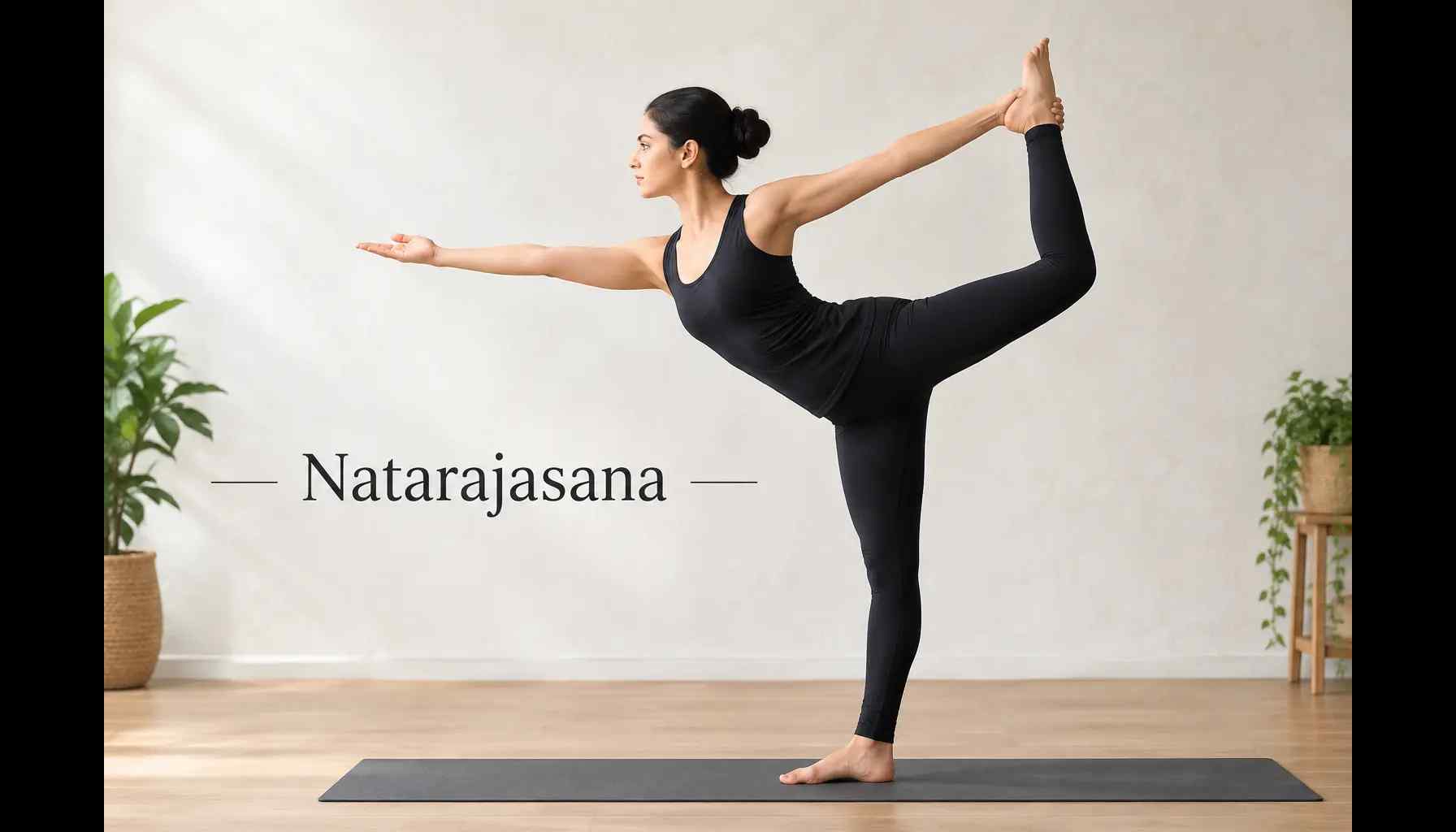
Natarajasana (Lord of the Dance Pose): Benefits
Natarajasana (Lord of the Dance Pose) is an elegant standing backbend that combines deep hip extension, shoulder opening, and single-leg stability. It is named after Lord Shiva in his cosmic dancing form.
Incorporating this dynamic posture into your regular practice builds mental focus, strengthens postural support, and counters the tight posture caused by prolonged sitting.
Understanding Natarajasana (Lord of the Dance Pose)
Origin and Mythology
Natarajasana represents Shiva’s cosmic dance, symbolizing creation, transformation, balance, and grace.
Its movements reflect Nataraja’s dynamic dance, combining strength, flexibility, focus, and poise.
Anatomy and Alignment in Natarajasana
Safe performance of Natarajasana involves the proper engagement and flexibility of the following kinetic chains:
- Stability of the Supporting Leg: The supporting foot remains anchored to the mat surface with the knee kept straight by the engaged quadriceps and gluteus medius.
- Extension of Hip Flexors and Quads: Extension of the leg at the hip joint engages the psoas major, iliacus, and rectus femoris muscles.
- Expansion of the Shoulders and Chest: The action of reaching for the inner ankle engages the pectoralis major and anterior deltoid muscles.
- Core Activation: Deep abdominal muscles, including the transversus abdominis, stabilize the pelvis to protect the lumbar spine from overextension.
Preparatory Poses
Begin with Tadasana, Anjaneyasana, Virabhadrasana I, and Gomukhasana before practising Natarajasana.
These poses prepare the hips, shoulders, legs, chest, and core effectively.
Counter Poses
Follow Natarajasana with Balasana, Uttanasana, and Paschimottanasana for gentle release afterward.
These counter poses relax the spine, legs, hips, and back muscles.
Step-by-Step Guide to Practicing Natarajasana Safely
- Tadasana (Mountain Pose): Assume an erect posture with feet at hip distance from each other and weight evenly distributed between the feet.
- Weight Shift and Right Knee Bend: Place weight on the left leg, bend the right knee, and bring the heel close to the right buttock area.
- Ankle Hold: Extend the right arm backwards and hold the inner side of the right foot or ankle in order to externally rotate the shoulder.
- Extend the Left Arm: Lift your left arm straight up toward the ceiling, keeping your shoulder relaxed and down away from your ear.
- Kicking into the Backbend: Press your right foot back into your hand to lift the thigh while hinging slightly forward from the hips. Keep your chest lifted and hips square to the front.
- Hold and Release: Maintain a steady focal point (drishti) for 5 to 8 breaths. Carefully release the foot back to Tadasana and repeat on the opposite side.
Pose Variations and Modifications
|
|
|
|
|
|
|
|
|
|
|
|
|
|
|
|
|
|
|
|
Health Conditions and Diseases Managed by Yoga
Incorporating Natarajasana (Lord of the Dance Pose) into a therapeutic yoga routine helps address several physical and posture-related issues:
- Postural Kyphosis & Rounded Shoulders: Reverses slouching by stretching tight chest muscles and strengthening upper back extensors.
- Mild Sciatica & Hip Stiffness: Stretches the psoas and hip flexors, taking pressure off the lower back and lumbar vertebrae.
- Chronic Balance Impairment: Challenges neuromuscular coordination, strengthening ankle stabilizers and improving proprioception.
- Mild Stress & Anxiety: Demands steady concentration and deep breathing, which helps reduce nervous tension and regulate the nervous system.
Key Precautions
Consider the following precautions:
- Low Back Injuries: Avoid kicking back too deeply if you have acute lumbar disc herniations or lower back pain; focus on lifting the chest rather than arching the lower back.
- Unstable Ankle or Knee Joints: Practice near a wall or use a chair for support to prevent joint strain.
- High or Low Blood Pressure: Avoid holding your breath while holding the pose; keep your breathing deep and steady.
Final Thoughts
Mastering Natarajasana demands patience and persistence. This asana calls for proper alignment instead of lifting the leg as high as possible.
With the use of strength, flexibility, and controlled breath, Natarajasana promotes the development of functional balance and good spine condition. Try incorporating this balance backbend in your practice to strengthen your spine and chest, as well as improve your posture.
Frequently Asked Questions
1. What is Natarajasana and its benefits?
Natarajasana (Lord of the Dance Pose) is a standing balancing backbend that stretches the chest, shoulders, and hip flexors while strengthening the legs, ankles, and core to improve posture and balance.
2. What is a pyramid pose?
Pyramid Pose (Parsvottanasana) is a standing yoga posture where the legs are stepped straight into a staggered stance while the torso folds forward over the front leg to deeply stretch the hamstrings, hips, and spine.
3. How long should you hold Lord of the Dance Pose during practice?
Beginners should aim to hold the pose for 15 to 30 seconds (about 3 to 5 deep breaths) per side, gradually building up to 60 seconds as balance and flexibility improve.
4. Can beginners perform Natarajasana with props?
Yes, beginners can hold onto a wall for stability or loop a yoga strap around the back foot if reaching the ankle directly causes strain in the shoulders or quadriceps.
5. Why can't I balance in this pose?
Poor balance may result from limited ankle stability, weak core engagement, or an inconsistent gaze, so practise near a wall and maintain a steady drishti.
Also Read: Hatha Yoga
By Umesh Kumar Khiri

Discussion (0)
No comments yet. Be the first to comment!
Leave a Comment
You need to login to post a comment.