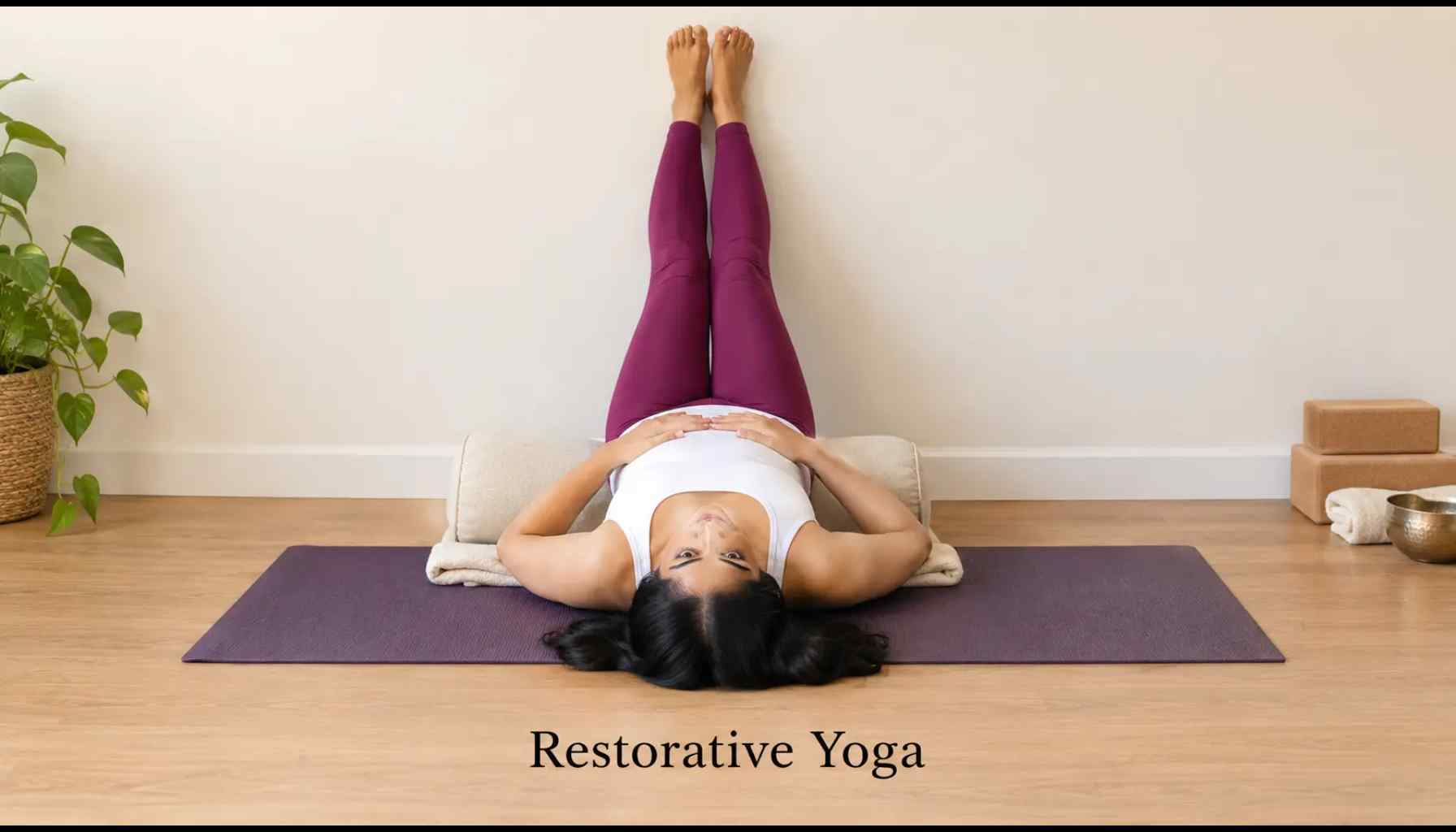
Restorative Yoga: Poses and Benefits
Restorative yoga is a slow, deeply relaxing style of yoga that uses props like bolsters, blankets, and blocks to fully support the body in passive poses. Instead of building strength or flexibility, the goal is complete rest, allowing the nervous system to shift out of a stressed, active state and into calm, healing relaxation. Poses are typically held for five to twenty minutes, making it one of the gentlest yoga styles available.
Key Takeaways
- Props fully support the body, requiring zero effort.
- Long, passive holds calm the nervous system deeply.
- Focuses on rest and recovery, not fitness.
Restorative Yoga Poses to Try
1. Supported Child’s Pose – Balasana
Pose depth: Gentle forward fold with full torso support.
Steps:
- Kneel with bolster in between thighs.
- Fold trunk over bolster.
- Relax your shoulders and breathe slowly.
2. Supta Baddha Konasana – Reclining Bound Angle Pose
Pose depth: Gentle hip opening with supported knees.
Steps:
- Lie back comfortably on a mat.
- Join the soles of your feet.
- Support your knees with blocks and breathe.
3. Viparita Karani – Legs-Up-The-Wall Pose
Pose depth: Gentle inversion that rests the legs.
Steps:
- Sit beside a wall for support.
- Extend legs upward.
- Rest arms comfortably on a mat and relax.
4. Supported Matsyasana – Supported Fish Pose
Pose depth: Gentle chest opening with spinal support.
Steps:
- Place bolster along your spine.
- Lie back over it.
- Relax arms and breathe deeply.
5. Supported Savasana – Supported Corpse Pose
Pose depth: Deep restorative rest with complete body support.
Steps:
- Lie comfortably on your back.
- Place bolster under knees.
- Cover yourself with a blanket and rest.
Counter Poses
- Gentle Seated Twist – After backbends like Supported Fish, sit up and twist gently to neutralize the spine. It helps you stretch and relax.
- Knees-to-Chest Pose – After hip openers like Reclined Bound Angle, hug the knees in to release the lower back. It builds flexibility.
What to Expect from a Restorative Yoga Class?
Restorative yoga class typically takes anywhere between 45-75 minutes where only 4-6 poses are practiced but for longer periods of time, and practicing 1-2 times a week is sufficient to experience the benefits of this practice. This practice takes place in a very quiet and dimly lit room with the abundance of props, minimal physical effort involved, so wear comfortable clothes.
Why Are Props Needed in Restorative Yoga?
Bolsters, blocks, blankets, and straps can help to support the body in yoga positions and minimize muscular exertion. They make it easier for the practitioners to remain comfortable and relaxed.
How Does Music Make Restorative Yoga Practice Even More Effective
The calm instrumental music or the ambient sounds help to relax because it helps to quiet the mind and block out any possible distractions from the surroundings. The slow rhythm of the music at 60-80 beats per minute automatically regulates the rhythm of the breathing and the heartbeat making the body enter the state of deeper relaxation and rest in each pose.
Restorative Yoga vs. Yin Yoga
Some of the key differences between Restorative Yoga and Yin Yoga are as follows:
|
|
|
|
|
|
|
|
|
|
|
|
|
|
|
|
|
|
|
|
|
|
|
|
Health Benefits of Restorative Yoga
- Parasympathetic nervous system activation for deep relaxation
- Cortisol reduction and stress reduction
- Improves sleep quality and treats insomnia
- Slowly increases flexibility without causing any harm
- Helps in releasing emotions and gaining clarity of mind
- Reduction in blood pressure and heart rate
- Also helps recover from fatigue or burnout
Diseases Managed: Conditions like chronic stress, anxiety, insomnia, fatigue, and burnout can be managed using restorative therapy.
Precautions
- Avoid staying in positions that may lead to numbness or tingling for a prolonged period.
- Utilize additional props if pregnant, suffering from injury, or dealing with chronic pain.
- Exit the positions slowly to avoid dizziness.
- Seek advice from your doctor before practicing deep backbends in case of any spinal problems.
- The temperature of the room should be higher since the body cools during rest.
- Do not try to force an emotional release but let it occur naturally.
Common Errors
- Considering yoga nidra a mere light exercise rather than a full relaxation technique.
- Omitting the use of props and thus weakening the restorative properties of the position.
- Spending little time in the positions to get the maximum result.
- Contraction of the muscles instead of full relaxation.
- Practising yoga nidra in noisy conditions with bright lighting.
Who Benefits Most From Restorative Yoga
- Chronically stressed professionals find deep relief through extended, prop-supported relaxation.
- People recovering from illness or injury benefit from its gentle, low-exertion nature.
- Those with anxiety or insomnia experience calming effects that support better sleep and emotional balance.
Conclusion
Restorative yoga offers a rare invitation to simply stop and rest, using props to fully support the body while the mind and nervous system unwind. In our active society where movement is constantly valued, this practice can serve as an excellent counterbalance. It’s time to start taking care of your mind and body.
FAQs
1. What exactly is Restorative Yoga?
It's a passive, prop-supported yoga style focused entirely on deep rest and relaxation.
2. What's the difference between yin yoga and Restorative Yoga?
Yin targets connective tissue with mild stretch, while Restorative focuses purely on full-body relaxation.
3. Why do I cry during Restorative Yoga?
Deep stillness can release stored tension and emotion, which is a normal and common response.
4. What are the top 5 Restorative Yoga poses?
Supported Child's Pose, Reclined Bound Angle, Legs-Up-The-Wall, Supported Fish, and Supported Savasana.
Also Read: Yin Yoga
By Umesh Kumar Khiri


Discussion (0)
No comments yet. Be the first to comment!
Leave a Comment
You need to login to post a comment.