Sun Salutation Yoga: Mastering Surya Namaskar
Sun salutation yoga is a flowing sequence of about twelve linked poses that warms the whole body, links movement with breath, and works well as a daily warm-up. It looks complex at first, but once you learn the order, it becomes a smooth, repeatable routine. Surya Namaskar is rooted in ancient Vedic traditions and can promote inner consciousness.
Key Takeaways
- Sun salutation yoga links twelve poses with breath into one flowing sequence.
- A complete routine includes practicing on both sides with each leg stepping back.
- Beginners can bend knees, step instead of jump, and start with a few slow rounds.
What Is Sun Salutation Yoga?
The sun salutation yoga derives its name from the Sanskrit language and means "greeting the sun." The asanas are performed in honor of Surya, who is considered the Hindu Sun God.
Its modern form became popular in the early 20th century, and teachers like Krishnamacharya later built flowing, vinyasa-style transitions on it, which influenced Ashtanga and Iyengar yoga. Today most people practice it as a fitness and mobility warm-up, though some traditions pair each step with a mantra.
The 12 Steps of Surya Namaskar (Sun Salutation Yoga)
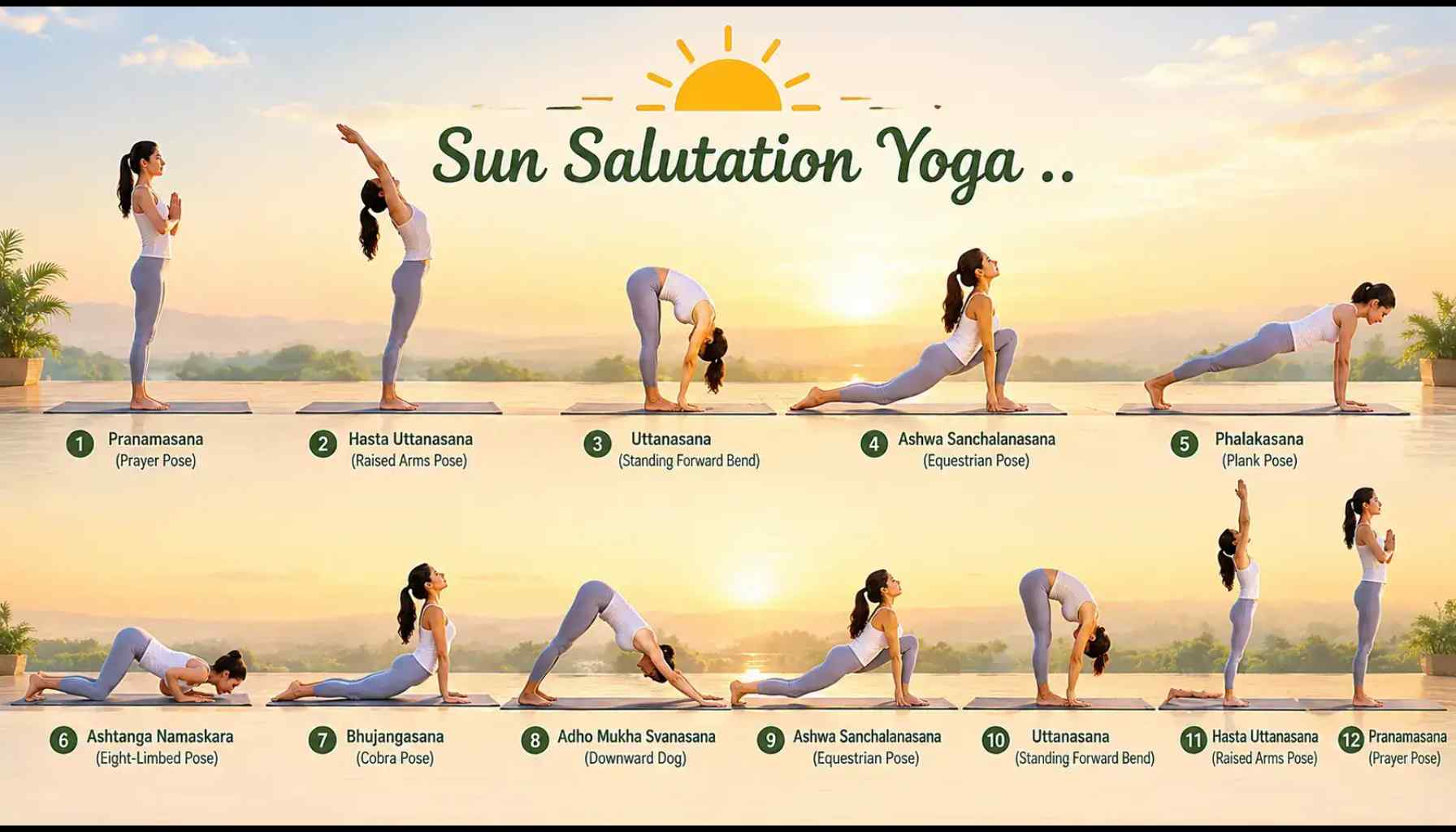
Move slowly and match each movement to your breath. This is the classic order used in many Sivananda-style classes.
- Mountain Pose (Tadasana), exhale: Stand tall with feet together and palms in prayer at your chest.
- Raised Arms Pose (Urdhva Hastasana), inhale: Sweep your arms overhead and arch gently back.
- Standing Forward Fold (Uttanasana), exhale: Hinge from the hips and place your hands beside your feet, bending your knees if needed.
- Low Lunge (Anjaneyasana), inhale: Move your right leg back, bend the knee, and lift the chest
- Downward-Facing Dog (Adho Mukha Svanasana), exhale: Step the other foot back, and lift the hips into an inverted V.
- Eight-Limbed Pose (Ashtanga Namaskara), hold the breath: Bring your knees, chest, and chin to the ground with hips raised.
- Cobra Pose (Bhujangasana), inhale: Slide forwards and lift the chest while bending the elbows.
- Downward-Facing Dog (Adho Mukha Svanasana), exhale: Tuck the toes, and move your hips back and up.
- Low Lunge (Anjaneyasana), inhale: Bring your right foot forward between the hands and left knee bent.
- Standing Forward Fold (Uttanasana), exhale: Move the back foot forward and bend over your legs.
- Raised Arms Pose (Urdhva Hastasana), inhale: Rise with a long spine and sweep your arms overhead.
- Mountain Pose (Tadasana), exhale: Come into prayer pose and bring your hands on the chest.
One Full Round at a Glance
Repeat the sequence with the opposite leg stepping back in steps 4 and 9 to complete one full round in many schools:
Mountain → Raised Arms → Forward Fold → Low Lunge → Downward Dog → Eight-Limbed Pose → Cobra → Downward Dog → Low Lunge → Forward Fold → Raised Arms → Mountain
Beginner Modifications
- Keep your knees bent when doing forward bends to safeguard your hamstrings and lower back.
- Take steps backward for your lunges, do not jump.
Modifications for Wrists, Knees, and Back
- Wrists: use forearms or fists in Downward Dog and Eight-Limbed Pose, or swap in Cat-Cow if weight on the hands hurts.
- Knees and back: pad Low Lunge with a blanket, keep knees bent in Forward Fold, and choose a low Cobra or Cat instead of a deep backbend.
Types of Sun Salutations
|
|
|
|
|
|
|
|
|
|
|
|
|
|
|
|
|
|
|
|
|
|
|
|
|
|
|
|
|
|
|
|
|
|
|
Which Sequence Should I Choose?
Choose the classical 12 steps for learning and practicing yoga; choose Sun Salutation A for a quick muscle strengthening routine; and Sun Salutation B for leg endurance.
Mantras: Start with “Om Mitraya Namah” when you begin your sun salutation, which is the greeting to the Sun as the friend to everyone, and end your practice with “Om Bhaskaraya Namah,” thanking the Sun for the light that he provides.
Health Benefits of Sun Salutation Yoga
- Flexibility: Provides flexibility as it stretches the hamstrings, hip joints, spine, and shoulders.
- Strength: Builds strength to the arms, shoulders, abdomen, and leg muscles.
- Increases physical activities of various intensities: Physical activity level is from light to vigorous depending on the intensity of the exercise.
- Reduces stiffness from prolonged sitting: Stretches the chest, hips, and the spine.
- Improves coordination and body awareness: Body awareness and coordination will improve because of synchronized breathing and movements.
Common Mistakes to Avoid
- Flowing rush: Move at a relaxed pace, using breath to lead the way.
- Elbows and knees locking: Make sure they stay bent for joint protection.
- Focusing on the lower back in cobra pose: Instead, arch your chest.
- Breath holding without reason: Try to maintain smooth breathing.
Conclusion
Sun salutation yoga is a simple exercise sequence that will help you become more flexible and stronger. Start with a few slow rounds, use modifications when needed, and let your holistic practice grow at its own pace. It’s time to cultivate mindfulness and balance in your lifestyle.
Frequently Asked Questions
1. What is the purpose of sun salutations in yoga?
They warm the body, build mobility and strength, and connect movement with breath, and in some traditions they are also a practice of honoring the sun.
2. What are the 12 poses of Sun Salutation?
The common sequence is Mountain, Raised Arms, Forward Fold, Low Lunge, Downward Dog, Eight-Limbed Pose, Cobra, Downward Dog, Low Lunge, Forward Fold, Raised Arms, and Mountain.
3. How many rounds of Surya Namaskar should a beginner do?
Many beginners start with two to four slow rounds, then add more gradually.
4. What will happen if I do 10 Surya Namaskar every day?
Research on sun salutation yoga shows that you may notice better flexibility, stamina, and strength over time. But results depend on your pace and overall routine.
Also Read: Sun and Moon Yoga

Discussion (0)
No comments yet. Be the first to comment!
Leave a Comment
You need to login to post a comment.