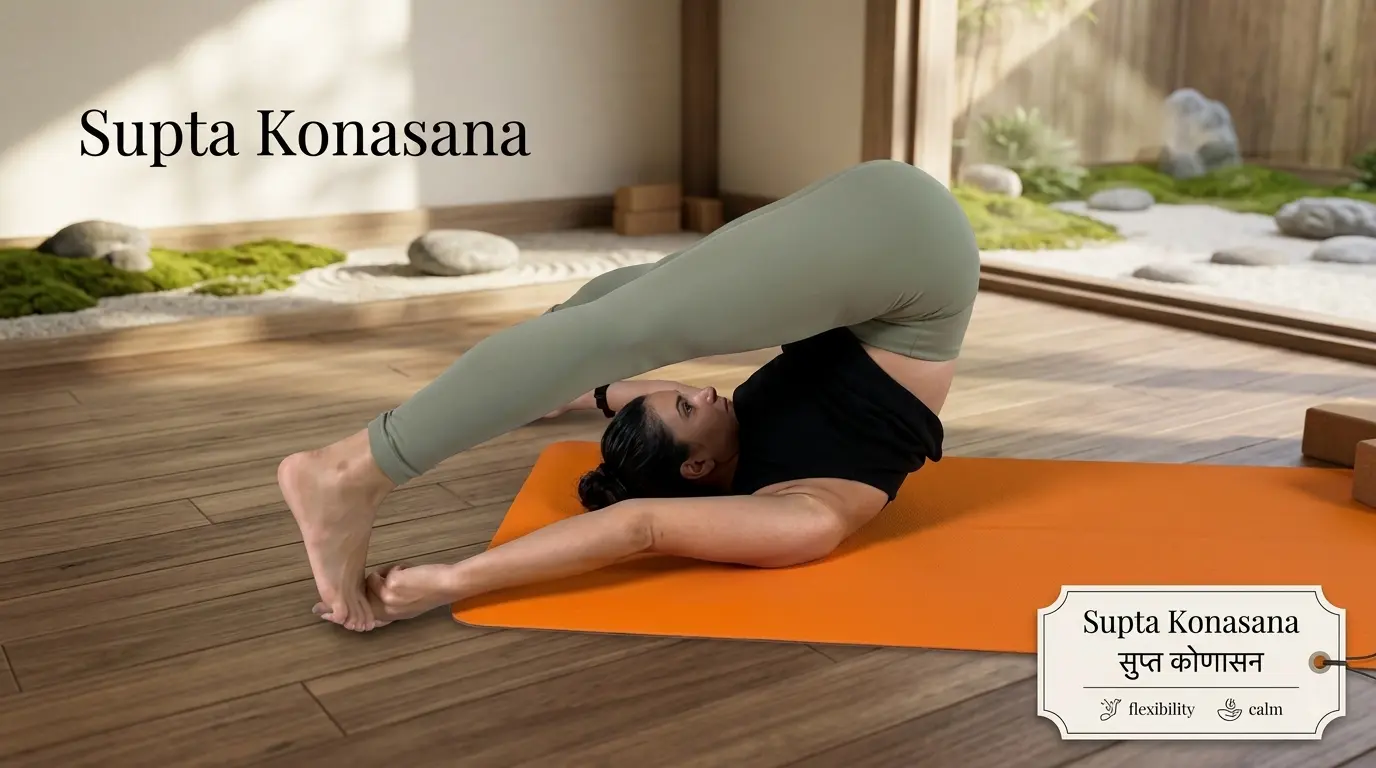
Supta Konasana: Reclining Angle Pose
Supta Konasana, or Reclining Angle Pose, falls into the category of more advanced inversion yoga poses. It involves an inverted pose along with opening of the legs, thereby allowing you to stretch your inner thighs, hips, and lower body while controlling your upper body.
Unlike the normal wide-angle opening pose from a sitting position, the Supta Konasana is mostly performed from the Sarvangasana, the Shoulder Stand pose. The importance of performing this pose is establishing a good shoulder stand, after which you gradually open your legs to a wide angle. Supta Konasana can be included in your yoga routine, which helps to regulate your energy levels.
Key Takeaways
-
Inverted Hip Opener: Combines a shoulder stand with a wide-leg stretch to open the hips and inner thighs.
-
Flexibility & Circulation: Enhances spinal mobility and boosts blood flow throughout the body.
-
Advanced & Mindful: Requires proper warm-up and shoulder support to practice safely.
What Is Supta Konasana (Reclining Angle Pose)?
The name of this asana indicates the basic structure of the asana itself. "Supta" is a Sanskrit word meaning reclined or lying down; "Kona" means an angle, and "Asana" is posture.
In the process of performing the Supta Kona asana, the person gets out of the inverted position and opens the legs up into a wide V position. Whether the hands will still support the back depends on the person’s flexibility.
Since the pose includes both the features of an inversion and a wide-leg position, it requires more preparation than a regular floor stretch pose.
Benefits of Supta Konasana (Reclining Angle Pose)
When practised appropriately, Supta Konasana can support flexibility, body awareness, and controlled movement.
|
|
|
|
|
|
|
|
|
|
|
|
|
|
|
|
|
|
|
|
|
|
|
|
How to Perform Supta Konasana
Supta Konasana being an advanced inversion, it should not be considered a basic stretching technique.
1. Begin from Stable Shoulder Stand
Start the practice from a stable shoulder stand in which the body is comfortably positioned. It is important not to move the head and not to turn the neck during the inversion.
2. Find Your Balance
Make sure that your breathing is smooth and controlled before opening your legs. The hands should keep support on the back of the body.
3. Open the Legs Gently
Gradually open both legs into the V position. It is not necessary to sharply separate the legs. The gentle process gives time for adaptation of the inner thighs and the hips.
4. Stay Comfortably
It is not necessary to go to a certain angle. You can stop when you feel comfortable and in a controlled position.
5. Position Your Hands Correctly
Practitioners with enough flexibility will eventually try to touch their feet or toes. This can be avoided by keeping the hands positioned to support the back.
6. Breathe Normally
Breathe normally during this posture. Don’t hold your breath, and don’t push yourself any deeper.
7. Exit With Care
Bring the legs together first before coming out of the inversion pose. Go into the Shoulder Stand and then come out carefully.
Precautions for Supta Konasana
The Reclining Angle Pose must be performed with caution since it involves an inversion together with wide legs.
- Do not move your head: The head must be kept stationary throughout the pose.
- Create a stable base: Practice this pose after getting comfortable with the Shoulder Stand.
- Open legs progressively: Do not drop legs instantly to create wide legs.
- Do not push beyond your flexibility limits: Maintain a comfortable zone of opening the legs.
- Protect your neck: Do not do this pose in case of any problems with your neck or cervical spine unless a specialist allows.
- Be careful with inversions: If you have certain eye disorders, hypertension, or other conditions that can be influenced by the inversion, consult a specialist.
- Try a modification: A modification with the use of legs up the wall is a good alternative to this pose.
- Stop once anything seems abnormal: Sharp pain, numbness, dizziness, or anything else abnormal is a cause for exiting this pose.
Final Thoughts
Supta Konasana is a yoga pose that combines several elements, including flexibility, inverted position, balancing, and breath control, into one demanding yoga pose. The pose with the wide legs apart could promote flexibility in the hips and inner thighs area, as well as in the inverted position.
However, the objective should not be the widest-legged position but to develop a stable basis through preparatory poses, gradual and natural breathing, and awareness of the body's current flexibility levels. In time, Supta Konasana may be incorporated into the regular yoga practice.
FAQs
1. What is the primary objective of Supta Konasana?
The pose mainly consists of an inverted posture together with a wide-leg pose. It puts stress on the inner thighs, hips, hamstrings, balance, and body control.
2. Do I have to reach my toes while practising the pose?
No. Reaching for the toes is not necessary. The pose can be practised by keeping your hands at the back supporting your body.
3. Why do we need to open the legs gradually in Reclining Angle Pose?
It prevents strain on the inner thighs and enables you to know the safe position before proceeding further.
4. What can I do as an alternative to Supta Konasana?
Practising a supported Viparita Karani with wide legs can be another good option.
Disclaimer: The content on LifePositive.com, including articles/blogs on yoga, acupuncture, naturopathy, and other alternative healing modalities for holistic wellness, is for informational and educational purposes only. It is not a substitute for professional medical advice, diagnosis, or treatment. Always consult a qualified healthcare provider before starting any new health protocol or making changes to an existing treatment plan.
Also Read: Chaturanga Dandasana
By Umesh Kumar Khiri

.png)
Discussion (0)
No comments yet. Be the first to comment!
Leave a Comment
You need to login to post a comment.