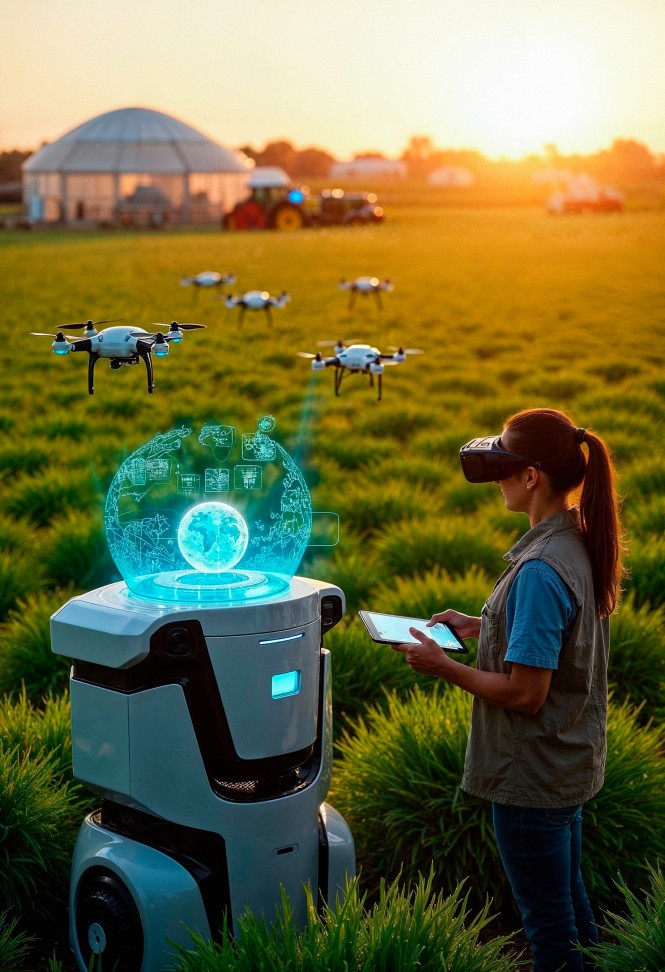
Farming with robots
Farming with robots is moving from concept to reality, addressing critical challenges like labor shortages and the need for more sustainable practices. These are not just automated tractors; they are intelligent machines capable of seeing, deciding, and acting with remarkable precision.
Here's a look at the key applications, the driving technology, and the benefits of this agricultural revolution.
What Robots Are Doing on Farms Today
Agricultural robots, or "agri-bots," are being deployed for a variety of precise tasks:
-
Precision Weeding: This is a major focus. Instead of blanket-spraying an entire field with herbicides, robots like the LettuceBot or SwarmFarm robots use computer vision to identify individual weeds. They can then remove them mechanically or apply a tiny, targeted dose of herbicide, potentially cutting overall herbicide use by up to 90%.
-
Autonomous Harvesting: Perhaps one of the most challenging tasks, robots equipped with AI and robotic arms are being developed to identify ripe fruits and vegetables and pick them without causing damage. This is crucial for crops like tomatoes, apples, and soft fruits where labor is scarce and costly.
-
Crop Scouting & Monitoring: Robots are becoming the farmer's eyes in the field. Ground-based rovers and aerial drones use an array of sensors, including LiDAR and high-resolution cameras, to monitor plant health, detect water stress, and spot the early signs of pest or disease outbreaks. This allows for rapid, targeted intervention. Some research even uses robot "dogs" to scout fields, bringing the technology closer to the ground for more detailed data.
-
Precision Seeding and Spraying: Robots can handle seeding and spraying with sub-50mm accuracy, ensuring seeds are planted at the optimal depth and spacing. This can improve germination rates and reduce waste of seeds and chemicals.
-
Safe Greenhouse Work: In controlled environments like greenhouses, robots are particularly effective. They can handle tedious tasks like spraying pesticides, which protects human workers from chemical exposure, and managing logistics like transporting harvested produce.
The Technology Behind the Machines
These robots are made possible by a convergence of advanced technologies:
-
Artificial Intelligence (AI) and Computer Vision: At their core, these robots rely on AI to "see" and make decisions. Deep learning algorithms and computer vision enable them to distinguish a weed from a crop, identify a ripe fruit, or spot a diseased leaf with high accuracy. For example, some algorithms can identify wheat ears with over 96% accuracy.
-
Advanced Sensors and Navigation: To navigate the unpredictable and unstructured environment of a farm, robots use a combination of technologies. LiDAR (Light Detection and Ranging) creates detailed 3D maps for navigation, while GPS and advanced localization systems like JABAS.AI help them operate even in areas with poor satellite signals, such as under tree canopies or in polytunnels.
-
Fleet Coordination and Swarm Robotics: The future of farming involves coordinated teams of smaller, lightweight robots. Swarm robotics uses fleets of cost-effective machines to work together, a system that is more adaptable and can be more cost-effective for smaller farms compared to relying on a single, massive tractor.
Core Benefits of Robot Farming
The push toward robotic agriculture is driven by powerful benefits:
-
Solves the Labor Crisis: The agricultural sector globally faces a severe shortage of farmworkers. Robots can perform repetitive, physically demanding tasks, reducing the need for manual labor by up to 90% in some cases. This allows farmers to manage operations with a smaller, more skilled workforce.
-
Reduces Environmental Impact: By applying inputs like herbicides, pesticides, and fertilizers with pinpoint accuracy, robots can dramatically cut chemical usage. Studies suggest this approach can reduce overall chemical input use by up to 30%, leading to less runoff and pollution.
-
Boosts Efficiency and Productivity: Data-driven decisions lead to better outcomes. By optimizing planting, irrigation, and harvesting, robots can improve crop yields (some farms report gains of 30% in cereal crops after adopting precision methods) and make farming more profitable.
Challenges on the Horizon
Despite the promise, widespread adoption faces hurdles. High initial capital investment is a significant barrier, especially for small-scale farmers. Technical challenges remain, such as ensuring robots can operate reliably in diverse and unpredictable weather and terrain conditions. There are also regulatory and data privacy concerns, along with a need for workforce training to manage this new technology.
We hopw these challwnges are overcome to make use of rhis new technology.
By Jamuna Rangachari



Discussion (0)
No comments yet. Be the first to comment!
Leave a Comment
You need to login to post a comment.