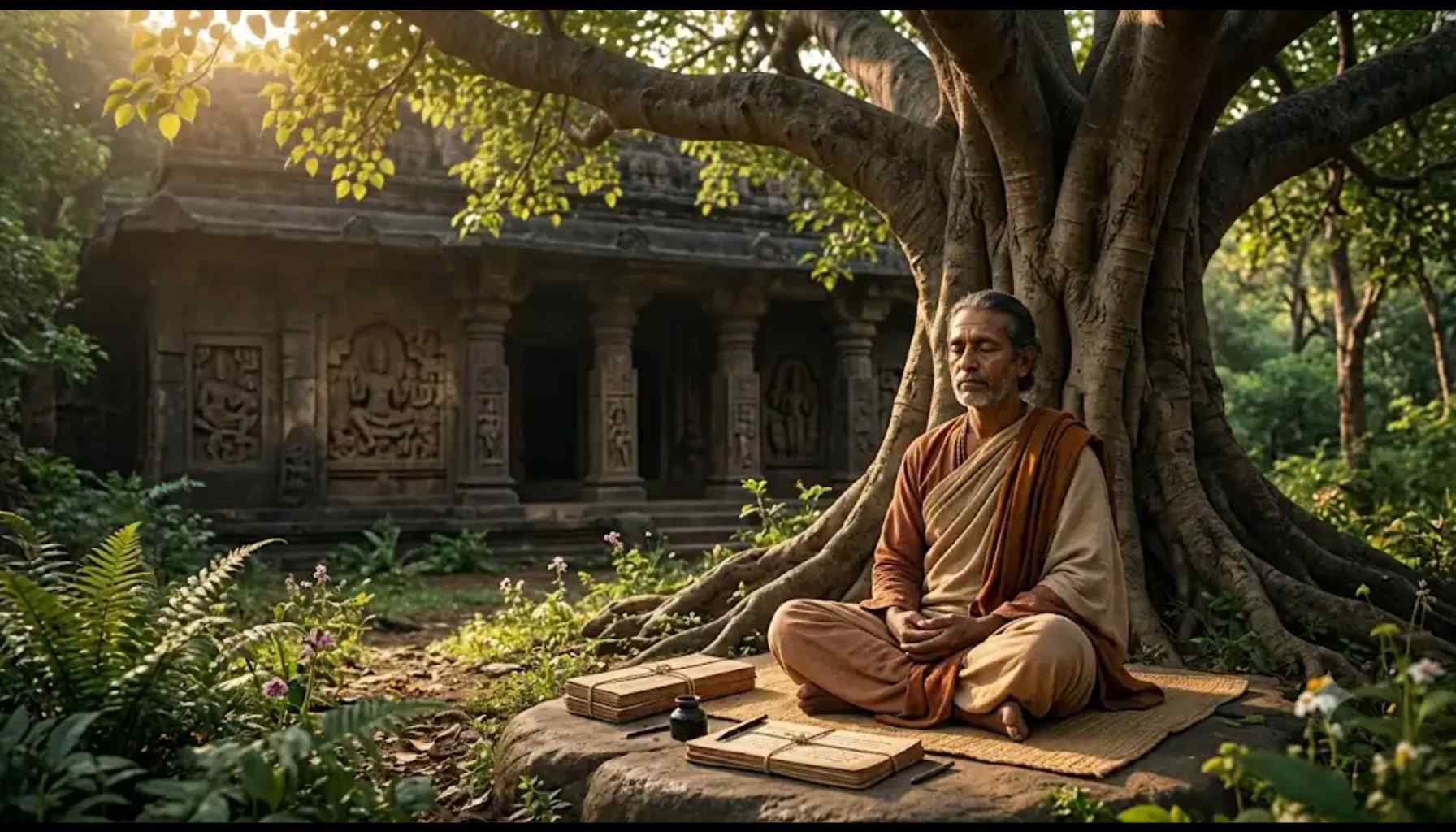
Meditation History: Surprising Origins and How It Evolved
Meditation history stretches back thousands of years, and it is far messier than the tidy “ancient Eastern secret” story many of us grew up with. No single person invented it. No single culture owns it. Nobody can point to a first day on the calendar. What we do have is a long trail of texts, teachers and traditions showing how people in very different places arrived at the same basic idea: train the mind, and life feels different.
This guide to meditation history follows that trail from prehistoric firesides to modern clinics and phone apps. Along the way, you will see what is well documented, what is educated guesswork, and which popular claims fall apart when you look at them closely.
Key Takeaways
- Meditation history has no single starting point, because early practices were passed down by speech long before anyone wrote them down.
- The oldest surviving written references come from India, in Vedic and Upanishadic texts, while Buddhist, Jain and Taoist traditions developed soon after.
- Almost every major religion built its own contemplative method, from Christian lectio divina to Sufi dhikr.
- Buddhism carried meditation across Asia along trade routes, where it blended with local ideas and became Chan, Zen and Tibetan practice.
- Meditation reached mainstream Western life in the 20th century, and Jon Kabat-Zinn’s 1979 program turned it into a clinical tool.
- Research suggests real benefits for anxiety, depression and sleep, but results are mixed for some conditions, and a minority of people have negative experiences.
What Do We Actually Mean by “Meditation”?
Before we trace meditation history any further, it helps to agree on the word itself, because it covers a surprisingly wide range of activity. Some practices ask you to rest your attention on one thing, such as the breath or a repeated phrase. Others ask you to simply watch whatever arises in your mind. A few involve slow movement, chanting or reflection on a sacred text.
The English word comes from the Latin meditari, which means to think over or ponder. In the 12th century, a Carthusian monk named Guigo II described meditation as one step in a structured way of reading scripture, and his work helped fix the term in Western religious vocabulary. By then, contemplative methods in India and China were already well over a thousand years old.
Because the word is so elastic, historians rarely attempt one grand story. Most research follows a single tradition at a time, whether Buddhist, Hindu, Christian or Taoist, so the bigger picture has to be pieced together from separate threads. That is what we will do here.
Prehistoric Roots: Did Early Humans Meditate?
Nobody can say for certain, and anyone who sounds sure is overstating the evidence. Still, one idea has drawn real attention. In 2007, psychologist Matt Rossano proposed that ritual gatherings around fires, perhaps 150,000 to 200,000 years ago, trained sustained attention and helped improve working memory in our ancestors.
That is a hypothesis, not a finding. Other researchers question parts of the argument, and trance-like ritual is not identical to what we call meditation today. Even so, hunter-gatherer societies around the world have long used drumming, chanting and guided inner journeys led by shamans, which hints that deliberate mental training is very old.
You may also come across claims that Indus Valley seals show people meditating in yoga postures. The best-known example, the so-called “Pashupati” seal, is still debated among archaeologists, and with no written record to explain it, the figure’s posture is open to interpretation. Treat that claim with caution when pinning down the origins of meditation, because meditation history is full of confident claims that outrun the evidence.
Ancient Meditation Practices in India: Where the Written Trail Begins
India holds the oldest written material that touches on meditation, which is why many timelines start there. But “oldest surviving text” does not mean “first practice.” These ideas were recited from memory for generations before anyone put them on paper, so the true origins of meditation sit somewhere earlier and out of reach.
Vedic and Upanishadic beginnings
Vedic literature, with roots in the second millennium BCE, contains early references to focused attention and inner vision. The Upanishads, composed over several centuries from roughly 800 BCE, go further. They explore dhyana, or sustained concentrated reflection, and connect it to the question of what the self really is.
Jain and Buddhist paths
Around the 5th century BCE, two reform movements, Jainism and Buddhism, placed meditation at the center of their teaching. Jain tradition pairs dhyana with strict ethical discipline. The Buddha described two broad approaches: samatha, which builds calm and steady attention, and Vipassana, which cultivates insight into how experience actually works.
One of the best-known Buddhist teachings, the Satipatthana Sutta, lays out mindfulness of the body, feelings, mind and mental patterns. Much of today’s secular mindfulness traces back to it, even when the religious framing has been removed.
The Bhagavad Gita and the Yoga Sutras
The Bhagavad Gita devotes a full chapter to disciplined meditation. The Yoga Sutras of Patanjali go further and set out an eight-limb path that includes concentration (dharana), meditation (dhyana) and absorption (samadhi).
A word of caution on dates. Scholars disagree about when the Yoga Sutras were compiled, with estimates ranging from about the 2nd century BCE to the 4th century CE. Any source that gives one precise year is simplifying a debate.
Meditation in China: Taoist Stillness and Quiet Sitting
Chinese thinkers developed their own contemplative methods. Taoist writings such as the Zhuangzi, from around the 4th to 3rd century BCE, describe “sitting and forgetting,” a state where rigid thinking loosens and the mind settles. Later, Confucian scholars of the Song dynasty practiced “quiet sitting” as a way to cultivate clarity and moral focus.
When Buddhism reached China in the early centuries CE, its meditation methods mixed with Taoist ideas about breath and stillness. Over time, that blend produced Chan Buddhism, which later spread to Korea, Vietnam and Japan, where it became known as Zen.
How Buddhism Carried Meditation Across Asia
Trade routes such as the Silk Road carried merchants, monks and manuscripts in both directions, and ancient meditation practices traveled with them. A Japanese monk named Dosho is traditionally credited with studying meditation in China in 653 and bringing it home. Zen schools took firm root in Japan later, in the 12th and 13th centuries, through teachers such as Eisai and Dogen.
Tibetan Buddhism took shape from about the 7th and 8th centuries, adding visualization, mantra and mandala practice. Meanwhile, monks in Sri Lanka, Burma and Thailand preserved the Pali teachings on samatha and Vipassana. Those lineages would later fuel the insight meditation movement in the West.
Meditation Traditions in the West and the Middle East
Western contemplation is not a modern import, and it deserves a place in any honest history of meditation. Greek and Roman thinkers practiced reflective routines. Stoics such as Epictetus and Marcus Aurelius recommended daily mental review and rehearsing difficulty in advance, and the Neoplatonist Plotinus, in the 3rd century CE, described turning inward toward a single source of reality.
Jewish contemplative practice also runs deep. A verse in Genesis describes Isaac going out into a field, a word that commentators have often read as meditation or reflective prayer, and later Kabbalistic traditions used letters and divine names as objects of focus.
Christian meditation grew out of the Desert Fathers and Mothers of Egypt, who repeated short phrases of scripture from roughly the 3rd to 5th centuries. Eastern Orthodox monks developed the Jesus Prayer, monastic communities in the West practiced lectio divina, and Ignatius of Loyola’s 16th-century Spiritual Exercises gave imaginative meditation a formal structure.
In Islam, Sufi orders developed dhikr, the rhythmic remembrance of God, often coordinated with breath, and muraqaba, a watchful, inward waiting. Each of these paths has its own goals, which is worth remembering before assuming every technique points to the same destination.
A Meditation Timeline at a Glance
If you prefer the short version, this meditation timeline pulls the major milestones into one place. Dates marked “c.” are approximate, and some early entries are debated.
|
Period |
Milestone |
|
Possibly 200,000–150,000 years ago |
Hypothesis that fireside ritual trained attention in early humans (debated) |
|
c. 1500 BCE onward |
Vedic oral tradition in India lays groundwork for later contemplative thought |
|
c. 800–200 BCE |
Upanishads explore dhyana and the nature of the self |
|
c. 5th century BCE |
The Buddha teaches samatha and Vipassana; Jain meditation develops |
|
c. 4th–3rd century BCE |
Taoist texts such as the Zhuangzi describe stillness and “sitting and forgetting” |
|
c. 2nd century BCE–4th century CE |
Yoga Sutras of Patanjali compiled (exact date disputed) |
|
3rd–5th century CE |
Plotinus writes on inward contemplation; Desert Fathers practice repetitive prayer |
|
7th century CE |
Buddhism takes root in Tibet; Dosho carries Chan teachings from China to Japan in 653 |
|
12th century |
Guigo II describes a four-step method of reading and contemplation |
|
12th–13th century |
Zen schools become established in Japan |
|
1893 |
Parliament of the World’s Religions in Chicago introduces Asian teachers to Western audiences |
|
1950s–1960s |
Transcendental Meditation and Zen spread widely; the Beatles visit Rishikesh in 1968 |
|
1975 |
Herbert Benson publishes The Relaxation Response; Insight Meditation Society opens in Massachusetts |
|
1979 |
Jon Kabat-Zinn launches mindfulness-based stress reduction at UMass Medical School |
|
2000s–today |
Mindfulness-based therapy, workplace programs and meditation apps go mainstream |
How Meditation Reached the Modern West
Western curiosity grew in the 18th and 19th centuries as European scholars translated Sanskrit and Pali texts. American Transcendentalists such as Ralph Waldo Emerson and Henry David Thoreau read the Bhagavad Gita with real interest. Then, in 1893, the Parliament of the World’s Religions in Chicago put teachers from India, Sri Lanka and Japan in front of large Western audiences.
The mid-20th century brought a bigger wave. D. T. Suzuki lectured on Zen in the United States, and Jack Kerouac’s novel The Dharma Bums (1958) pushed Buddhist ideas into popular culture. Maharishi Mahesh Yogi began teaching Transcendental Meditation in India in 1955, then took it abroad, and the Beatles’ 1968 visit to his ashram in Rishikesh made it famous.
Teachers from the Vipassana lineage also found Western students. Several of them helped found the Insight Meditation Society in Barre, Massachusetts, in 1975. That same year, Harvard physician Herbert Benson described the “relaxation response,” giving doctors a physiological way to talk about what meditators had long reported.
The decisive moment for medicine came in 1979, when Jon Kabat-Zinn started the eight-week mindfulness-based stress reduction program at the University of Massachusetts Medical School. It stripped away religious language and focused on practical skills. Researchers later paired mindfulness with cognitive therapy to create a program for preventing depression relapse, and by the 2010s, apps and workplace schemes had taken the practice to millions of people. Seen on a meditation timeline, the 20th century moves faster than all the centuries before it, and that chapter is arguably the biggest turning point in meditation history so far.
What Does the Science Say About Meditation Today?
Scientific study is one of the newest chapters in meditation history, and research has grown rapidly since the 1970s. The picture is encouraging but not unlimited. The National Center for Complementary and Integrative Health summarizes the evidence this way: mindfulness-based practices may help with anxiety and depression, may improve sleep, and have shown mixed results for pain, with stronger evidence for chronic pain than for acute pain. These are the most credible benefits of meditation, and none of them make it a cure-all.
Safety deserves honest attention too. Most people have few problems, but in an analysis covering more than 6,000 participants, about 8 percent reported negative effects, most often anxiety or depression. If you have a history of trauma or a mental health condition, speak with a health professional first and look for a qualified teacher.
Common Myths About the History of Meditation
“Meditation is purely Eastern.” Contemplative traditions also grew in Greece, Judaism, Christianity and Islam, as we saw above. Asian traditions are only part of the story.
“It is exactly 5,000 years old.” You will see this figure everywhere, but it rests on shaky ground. The oldest written traces are roughly 3,500 years old, and anything older is inference.
“You must sit cross-legged.” Walking, chanting, praying and movement have all been part of the record. Even the Yoga Sutras describe the ideal seat simply as steady and comfortable.
“Meditation is always religious.” Its roots are largely religious, yet many modern programs are deliberately secular. People can benefit from the techniques without adopting any belief system, and many choose faith-based forms because they find them meaningful. Both paths are legitimate.
Clearing up these myths makes the history of meditation easier to trust and easier to learn from.
Why Meditation History Matters for Your Own Practice
Knowing where a technique comes from, whether it is one of the ancient meditation practices or a modern adaptation, helps you choose one that fits your goals. Concentration methods, such as mantra repetition or breath focus, build steady attention. Insight methods, such as Vipassana and mindfulness, build awareness of thoughts and feelings. Devotional forms, such as centering prayer or dhikr, aim at a relationship with the sacred.
If you are curious about how to meditate, start small. Five minutes a day is plenty at first. Learn from a qualified teacher where you can, and respect the traditions that preserved these methods long before they became wellness trends.
Frequently Asked Questions About Meditation History
Where did meditation originate?
Nobody knows exactly. The oldest written references come from India, in Vedic and Upanishadic texts dating from about 1500 BCE onward, but oral practices almost certainly came earlier. Similar methods also developed in China, Greece and the Middle East, which is why the true origins of meditation remain uncertain.
How old is meditation?
Most careful accounts of meditation history point to at least 3,500 years of written evidence. Some researchers suggest far older roots in prehistoric ritual, but that remains a hypothesis rather than an established fact.
Who invented meditation?
No one person did, which is a recurring theme in meditation history. It is better understood as a human capacity that many cultures developed and refined independently. Influential figures include the Buddha, Mahavira, Patanjali, the Desert Fathers and, in modern times, Jon Kabat-Zinn.
When did meditation become popular in the West?
Gradually. Interest began in the 19th century, surged in the 1960s and 1970s with Transcendental Meditation, Zen and Vipassana, and entered mainstream healthcare after 1979. Meditation apps then broadened its reach from the 2010s onward.
Is meditation a religion?
No. Many religions use meditation, but practicing it does not require belief in anything. Secular programs such as mindfulness-based stress reduction were designed without religious content, though you can also choose a faith-based approach if that suits you.
Bottom Line: What Meditation History Teaches Us
Meditation history shows a practice that kept reappearing wherever people asked how to live with a restless mind. It grew in forests, monasteries, deserts, temples and laboratories, and it kept changing shape without losing its core purpose.
Whether you come to it for spiritual reasons, stress relief or plain curiosity, the useful lesson is the same. Treat bold claims about its age with care, respect the traditions behind it, and let your own experience guide you.

Discussion (0)
No comments yet. Be the first to comment!
Leave a Comment
You need to login to post a comment.