

Last Updated: November 24, 2026
Quick Summary
You can manage anxiety without therapy by building a steady daily routine that starts with consistent sleep, adds twenty to thirty minutes of movement most days, and layers in one five-minute relaxation technique done at the same time daily. Self-help suits mild to moderate anxiety, but see a professional if anxiety is severe, worsening, or affecting daily functioning.
- Use diaphragmatic breathing in a four-four-six count for two minutes to settle a stressful moment.
- Grounding by naming five things you see, four you hear, and three you touch pulls attention back to the room.
- Set a ten-minute worry window and postpone worries to it to interrupt overthinking loops.
- Limit caffeine and alcohol, which can raise heart rate or disrupt sleep and worsen anxiety symptoms.
- Do a weekly check-in noting anxiety frequency, intensity, sleep, and impact on your day.
Table of Contents
- When Self-Help Is Enough and When It Isn’t
- How to Reduce Anxiety Immediately at Home
- How to Deal With Anxiety When Alone
- How to Reduce Anxiety and Overthinking
- Foods That Reduce Anxiety Fast (and What to Limit)
- Building a Daily Routine That Lowers Anxiety
- Frequently Asked Questions
When Self-Help Is Enough and When It Isn’t
Learning how to manage anxiety without therapy is a realistic goal for many people, but it comes with an important condition: you need to know when self-help is enough and when it isn’t. The goal is managing anxiety without therapy, not avoiding all professional care. Those are two very different things.
A useful way to think about it is a ladder. Self-help sits at the bottom rung, and you climb only when the rung below stops holding you.
Rung 1, Self-help is likely enough when your anxiety is mild to moderate, tied to clear triggers, and doesn’t stop you from working, sleeping, or seeing people. Everyday worry, exam nerves, a stressful project, or a difficult conversation usually respond well to routine, movement, sleep, and breathing work.
Rung 2, Self-help is worth trying alongside a check-in when anxiety is moderate but persistent, or when it is starting to affect sleep, appetite, or concentration.
Rung 3, Self-help is not enough when anxiety is severe, lasting, or getting worse, or when it starts to affect your daily functioning. It also isn’t enough when you are relying on alcohol or other substances to cope, when panic attacks keep returning, or when anxiety stops you leaving the house.
Watch out: the most common mistake is treating self-help as a test of willpower. If you have tried the basics for several weeks and things are not steadier, that is information, not failure. It is a signal to reassess, not to try harder alone.
The NHS guidance on generalised anxiety disorder is clear that talking therapies are a first-line option for many people, and self-help sits alongside them rather than replacing them.
Seek prompt medical advice if you notice:
- Panic attacks that keep returning
- Thoughts of harming yourself
- Anxiety that stops you leaving the house
- Physical symptoms like chest pain or breathlessness
- Anxiety that is getting worse despite consistent self-help
For a fuller overview of anxiety and its treatment options, our guide on overcoming anxiety walks through the process and benefits. If work pressure is the main driver, these strategies for managing anxiety at work may help.
How to Reduce Anxiety Immediately at Home
To reduce anxiety immediately at home, use slow breathing and grounding first. These can help you settle during a stressful moment.
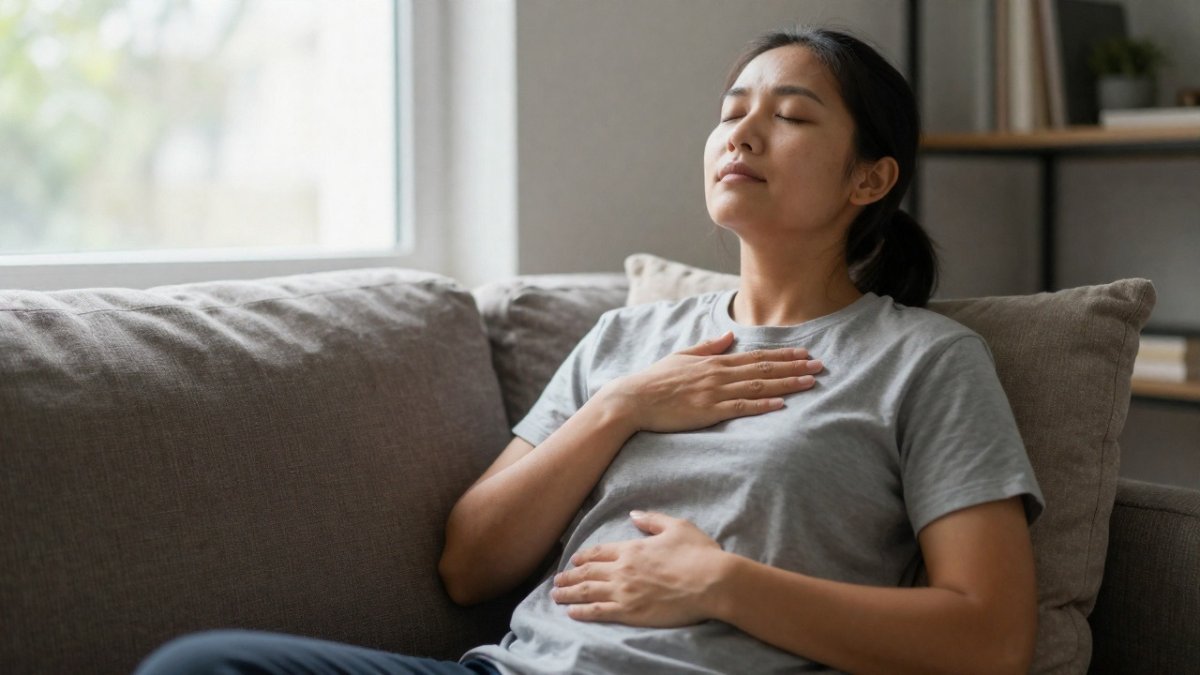
Diaphragmatic breathing is a simple technique many people find useful. It means breathing from your belly rather than your chest.
Try this sequence:
- Sit down and place one hand on your chest, one on your belly
- Breathe in through your nose for a count of four
- Hold for four
- Breathe out slowly for six
- Repeat for two minutes
Grounding pulls attention back to the room. Name five things you can see, four you can hear, and three you can touch. It sounds simple because it is, and that’s the point.
Other fast options:
- Splash cold water on your face
- Press your feet hard into the floor and notice the pressure
- Hum slowly, which lengthens the exhale
- Step outside for two minutes of fresh air
If you want a physical practice, gentle yoga is one of the most reliable in-the-moment tools. Our guide to stress-reducing yoga with six poses covers poses, benefits, and simple precautions.
How to Deal With Anxiety When Alone
Dealing with anxiety when alone comes down to preparation. Decide in advance what you will do, so you aren’t making decisions mid-panic.
A short written plan helps more than most people expect. Keep it where you can see it.
Your alone-time plan could include:
- One breathing technique you know works
- One grounding exercise
- A calming playlist you’ve already made
- A person you can call, even just to talk
- A simple task that uses your hands
Calming music is a low-effort option that many people find soothing, though it does not replace the basics.
What most guides miss is the value of body awareness. Anxiety often shows up as muscle tension in the jaw, shoulders, or stomach before you notice the worry. Scan your body and consciously relax those areas.
Journaling helps here too. Write down what you’re feeling for three minutes without editing. Getting it out of your head reduces the loop. (Source: clinical research on the efficacy of self-help interventions)
How to Reduce Anxiety and Overthinking
Reducing anxiety and overthinking means interrupting the loop, not solving the thought. Rumination feels productive. It rarely is.
A common mistake is trying to think your way out of a worry. The more you analyze, the more the loop tightens.
Try these instead:
- Set a ten-minute “worry window” and postpone worries to it
- Ask whether the thought is a problem to solve or a fear to sit with
- Write the worry down and close the notebook
- Move your body, since physical activity interrupts mental loops
- Name the thought type: “this is catastrophizing”
Cognitive behavioral therapy techniques are often discussed as useful here, and some basics can be learned on your own. A common idea in cognitive approaches is to notice a thought, check it against evidence, and consider a more balanced view.
If overthinking is your main pattern, our step-by-step guide on avoiding overthinking covers the process in more depth, including healthy lifestyle practices that support it.
Foods That Reduce Anxiety Fast (and What to Limit)
No food reduces anxiety instantly, but some support steadier mood, and some make symptoms worse. That’s the honest version.
A balanced diet supports overall wellbeing. Aim for regular meals with protein, fibre, and healthy fats.
Foods commonly included in balanced eating:
- Oats and whole grains for steady energy
- Nuts and seeds
- Leafy greens
- Fatty fish
- Yogurt and fermented foods
- Bananas and berries
What to limit matters just as much. Caffeine can raise heart rate and mimic anxiety symptoms for some people. Alcohol may feel calming at first, but it can disrupt sleep (the NHS).
Watch out: cutting caffeine abruptly can cause headaches for some people, so reducing gradually is often easier.
Building a Daily Routine That Lowers Anxiety
A steady daily routine lowers anxiety more than any single technique. The reason is simple: predictability reduces the number of decisions and unknowns your mind has to process. But most guides stop at listing habits.
Start with sleep, because everything else depends on it. Keep consistent sleep and wake times, even at weekends. Limit screens before bed. A dark, cool room helps.
Add movement next. Regular physical activity is widely discussed as a helpful habit for anxiety. A brisk walk counts. You don’t need a gym.
Then layer in one relaxation technique. Mindfulness and meditation work best as small daily habits rather than long occasional sessions. Five minutes daily beats an hour once a week.
Finally, add structure around meals and wind-down. Regular meals with protein, fibre, and healthy fats are a sensible habit for many people. A wind-down hour before bed, dim lights, no work, no scrolling, protects the sleep you started with.
A simple weekly check-in keeps the plan honest. Once a week, note four things: how often anxiety showed up, how intense it was, how well you slept, and how much it affected your day.
Watch out: if things are getting worse rather than steadier over several weeks, that is your cue to speak to a professional, not to add more techniques.
Adapt the plan when a strategy stops helping. If breathing exercises no longer settle you, swap in grounding or a short walk.
At LifePositive, we connect people with certified healers and therapists, plus guides on meditation, Ayurveda, yoga, and mindfulness. If you want a structured starting point, our article on four habits to help reduce anxiety pairs well with the routine above.
The routine works best when built in a set order, starting with the habit everything else depends on.
| Step | What to do | Time or frequency |
|---|---|---|
| 1. Sleep | Keep consistent sleep and wake times, limit screens, dark cool room | Even at weekends |
| 2. Movement | Brisk walk counts; no gym needed | Twenty to thirty minutes most days |
| 3. Relaxation | One technique: breathing, body scan, or guided audio | Five minutes daily, same time each day |
| 4. Meals and wind-down | Regular meals with protein, fibre, healthy fats; dim lights, no work, no scrolling | Wind-down hour before bed |
| Weekly check-in | Note anxiety frequency, intensity, sleep, and impact on your day | Once a week, a few lines |
Anxiety doesn’t have to run your day.
Frequently Asked Questions
What is the 3-3-3 rule for anxiety?
The 3-3-3 rule is a grounding technique: name three things you can see, three sounds you can hear, and move three parts of your body. It pulls attention away from spiraling thoughts and back to your immediate surroundings. It works best as an in-the-moment tool during a spike of worry, not as a replacement for ongoing anxiety management. Pair it with slow breathing for a stronger effect.
When should I seek professional help for anxiety?
Consider professional support if anxiety interferes with work, sleep, or relationships for several weeks, if you avoid situations you used to handle, or if you notice worsening panic. Managing anxiety without therapy is a valid choice for mild to moderate symptoms, but it is not the same as avoiding all care. A qualified practitioner can assess whether talking therapy, medication, or a combined approach is appropriate for you.
Can foods really reduce anxiety fast?
No single food calms anxiety immediately, but some choices support steadier mood. Balanced eating is part of a healthy lifestyle, while heavy caffeine and alcohol can affect how you feel. Use food as part of a balanced diet rather than a quick fix, and check with a professional before adding supplements.
How can I deal with anxiety when I am alone?
Have a short written plan ready before anxiety hits: a breathing exercise, a grounding technique, and one person you can message. Keep a journal nearby to offload racing thoughts, and use calming music or a guided meditation recording. If you live alone and symptoms feel unmanageable, contact a helpline or a qualified practitioner rather than waiting it out.


